Licence: In copyright
Credit: The prevention of malaria. Source: Wellcome Collection.
Provider: This material has been provided by London School of Hygiene & Tropical Medicine Library & Archives Service. The original may be consulted at London School of Hygiene & Tropical Medicine Library & Archives Service.
39/768
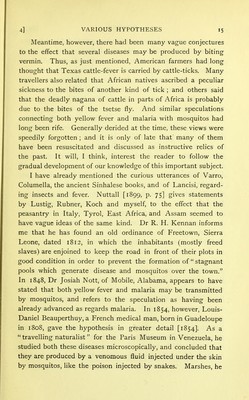
![Meantime, however, there had been many vague conjectures to the effect that several diseases may be produced by biting vermin. Thus, as just mentioned, American farmers had long thought that Texas cattle-fever is carried by cattle-ticks. Many travellers also related that African natives ascribed a peculiar sickness to the bites of another kind of tick ; and others said that the deadly nagana of cattle in parts of Africa is probably due to the bites of the tsetse fly. And similar speculations connecting both yellow fever and malaria with mosquitos had long been rife. Generally derided at the time, these views were speedily forgotten ; and it is only of late that' many of them have been resuscitated and discussed as instructive relics of the past. It will, I think, interest the reader to follow the gradual development of our knowledge of this important subject. I have already mentioned the curious utterances of Varro, Columella, the ancient Sinhalese books, and of Lancisi, regard- ing insects and fever. Nuttall [1899, p. 75] gives statements by Lustig, Rubner, Koch and myself, to the effect that the peasantry in Italy, Tyrol, East Africa, and Assam seemed to have vague ideas of the same kind. Dr R. H. Kennan informs me that he has found an old ordinance of Freetown, Sierra Leone, dated 1812, in which the inhabitants (mostly freed slaves) are enjoined to keep the road in front of their plots in good condition in order to prevent the formation of stagnant pools which generate disease and mosquitos over the town. In 1848, Dr Josiah Nott, of Mobile, Alabama, appears to have stated that both yellow fever and malaria may be transmitted by mosquitos, and refers to the speculation as having been already advanced as regards malaria. In 1854, however, Louis- Daniel Beauperthuy, a French medical man, born in Guadeloupe in 1808, gave the hypothesis in greater detail [1854]. As a travelling naturalist for the Paris Museum in Venezuela, he studied both these diseases microscopically, and concluded that they are produced by a venomous fluid injected under the skin by mosquitos, like the poison injected by snakes. Marshes, he](https://iiif.wellcomecollection.org/image/b21351600_0039.jp2/full/800%2C/0/default.jpg)