Licence: In copyright
Credit: The prevention of malaria. Source: Wellcome Collection.
Provider: This material has been provided by London School of Hygiene & Tropical Medicine Library & Archives Service. The original may be consulted at London School of Hygiene & Tropical Medicine Library & Archives Service.
641/768
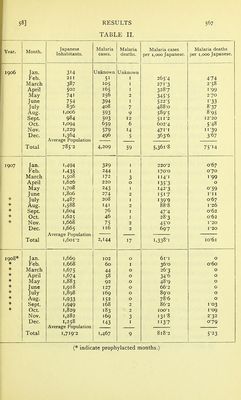
![costs more. It will scarcely be believed that in the second report of the experiment, designed, as has been declared, for the express purpose of providing official information for the whole of India, no accounts whatever of the cost incurred were vouchsafed! In fact, the whole affair was conducted on un- practical and unscientific lines. It proved nothing at all, and its only effect was to retard anti-malaria work in that and other countries for years. Since 1904 the military authorities at Mian Mir undertook much more patient and useful work there, with the apparent result of a considerable reduction in malaria — see especially H. D. Rowan [1908]. At the Bombay Medical Congress of 1909, however, S. P. James described how, during a recent visit to Mian Mir, he had found no reduction, either in the malaria or in the number of mosquitos. His statements were immediately controverted by five administrative medical officers (see Lancet, 3rd July 1909). James stated that out of ten men of the Gloucester regiment, who had been taking quinine regularly, and who were selected by him at Mian Mir more or less at random, he found parasites in no less than eight— an enormous percentage. The commandant of the regiment, however, informed me at Bombay shortly afterwards that his regiment had not suffered much from malaria at that time. Many local campaigns have been commenced in India, and will be found mentioned in the Annual Sanitary Reports, in the Proceedings of the Malaria Conference [1910], and in a recent publication by W. G. King [1909], and elsewhere. I have received many private communications regarding these, from which I gather that they have not been given much encourage- ment from headquarters, that the organisation has not been sufficient to ensure continuity, and that the necessary measure- ments of malaria have been quite inadequate. There is no doubt that the general policy of a clique in India has been opposed to mosquito reduction, and has not been very keenly interested in any other form of malaria campaign. A](https://iiif.wellcomecollection.org/image/b21351600_0643.jp2/full/800%2C/0/default.jpg)