Licence: In copyright
Credit: The prevention of malaria. Source: Wellcome Collection.
Provider: This material has been provided by London School of Hygiene & Tropical Medicine Library & Archives Service. The original may be consulted at London School of Hygiene & Tropical Medicine Library & Archives Service.
642/768
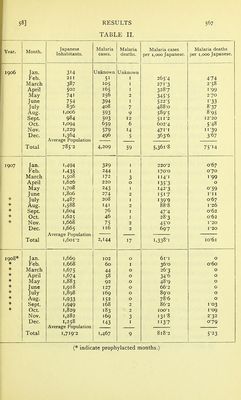
![party in that country has been advocating quinine on the Italian model, and appears to have persuaded the Government that it will cost nothing, while mosquito reduction must always be enormously expensive. Personally, I would welcome any measure that is effective, but apparently not even the quinine method has been fully pushed in that country. Experience will, I think, prove to the Government of India that no anti - malaria campaign can be conducted without expense; that each measure has its proper sphere of action; and that quinine may not always cost less than other measures. Up to the present the work in India seems to me to have been wanting both in intelligence and in leadership, in spite of the 1,000,000 deaths a year officially attributed to malaria there. In October 1909 an Imperial Malaria Conference was held at Simla. It was not, I think, arranged in a perfectly satisfactory way. Engineers and several good workers on the subject appear not to have been called. Nevertheless, the conclusions of the Conference simply confirmed my proposals, especially as put in my Mauritius report. I hope that the Conference will mark the beginning of a new era in India. C. A. Bentley has recently published a report on malaria in Bombay [1910]. A. G. M'Kendrick had found a splenic index of 629/8325 = 7-5%, and the author one of 3075/21,517 = I4'3%- The local carrier is Nyssorhynchus stephensi, which, unlike most Anophelines, breeds readily in deep wells, cesspits, cisterns and salt water. The author recommends a campaign against it (not including other mosquitos) chiefly by means of strict legislation aimed at the removal or protection of such waters by householders, and does not appear to advocate any special municipal organisation. Such legislation is certainly a necessary preliminary and easy to suggest; but in practice the cost of the numerous inspections and summonses required to enforce it is apt to exceed that of doing the work by departmental agency, as hygienists well know (axioms 6 and 7, section 38). Nevertheless, municipalities like the idea, because](https://iiif.wellcomecollection.org/image/b21351600_0644.jp2/full/800%2C/0/default.jpg)