Licence: In copyright
Credit: The prevention of malaria. Source: Wellcome Collection.
Provider: This material has been provided by London School of Hygiene & Tropical Medicine Library & Archives Service. The original may be consulted at London School of Hygiene & Tropical Medicine Library & Archives Service.
643/768
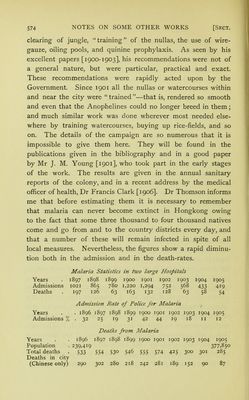
![it appears at first sight to put them to no expense. We generally observe two things about tropical municipalities— the excellence of their sanitary laws and the completeness with which the public ignores them. Which is the cheaper in the end, (a) to make one inspection and then do the work, or (b) to make many inspections, worry the householder, issue several summonses, be finally forced to do the work, and then try to recover the cost in the law courts ? We must always remember this question, and endeavour to arrange a proper balance between the respective obligations of the householder and the municipality. (2). Hongkong. — One of the earliest and best of the campaigns in British territory. The city of Victoria, usually called Hongkong, runs for nearly 5 miles along the north of the island of that name at the mouth of the Canton river in South-East China. The island, 11 miles long and from 2 to 5 miles broad, consists of a broken ridge of hills, rising to nearly 2,000 feet, and the city is built on a hill sloping down to the water, some of the terraces and houses being 500 feet above sea-level. There is also a large residential district on the mountains reached by a cable tramway. The soil is granitic. All along the face of the hill on which Victoria is built there are beds of streams, known as nullas, which used to swarm with Anopheline larvae. The population of the colony was 377,850 in 1905, of which 10,835 were whites (nearly half belonging to the British Army and Navy). The rainfall is from 70 to 80 inches a year. Malaria has been always very prevalent here, and I remember that in 1881 the colony was cited as an example of the telluric miasma due to decaying granite. The first researches on the new lines were commenced as early as May 1901 by Dr J. C. Thomson [1901], who undertook an exhaustive study of the mosquitos and their breeding-places. He examined over 32,000 specimens, of which he found about 4% to be Anophelines, and in November advised an active anti-malaria campaign by drainage,](https://iiif.wellcomecollection.org/image/b21351600_0645.jp2/full/800%2C/0/default.jpg)