Licence: In copyright
Credit: The prevention of malaria. Source: Wellcome Collection.
Provider: This material has been provided by London School of Hygiene & Tropical Medicine Library & Archives Service. The original may be consulted at London School of Hygiene & Tropical Medicine Library & Archives Service.
645/768
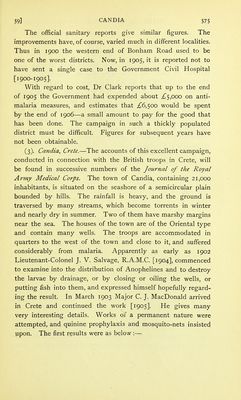
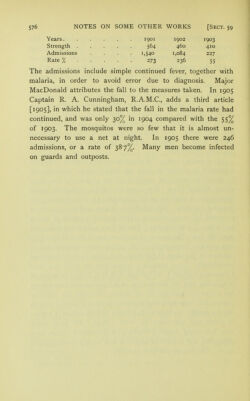
![The official sanitary reports give similar figures. The improvements have, of course, varied much in different localities. Thus in 1900 the western end of Bonham Road used to be one of the worst districts. Now, in 1905, it is reported not to have sent a single case to the Government Civil Hospital [1900-1905]. With regard to cost, Dr Clark reports that up to the end of 1905 the Government had expended about .£5,000 on anti- malaria measures, and estimates that £6,500 would be spent by the end of 1906—a small amount to pay for the good that has been done. The campaign in such a thickly populated district must be difficult. Figures for subsequent years have not been obtainable. (3). Candza, Crete.—The accounts of this excellent campaign, conducted in connection with the British troops in Crete, will be found in successive numbers of the Journal of the Royal Army Medical Corps. The town of Candia, containing 21,000 inhabitants, is situated on the seashore of a semicircular plain bounded by hills. The rainfall is heavy, and the ground is traversed by many streams, which become torrents in winter and nearly dry in summer. Two of them have marshy margins near the sea. The houses of the town are of the Oriental type and contain many wells. The troops are accommodated in quarters to the west of the town and close to it, and suffered considerably from malaria. Apparently as early as 1902 Lieutenant-Colonel J. V. Salvage, R.A.M.C. [1904], commenced to examine into the distribution of Anophelines and to destroy the larvae by drainage, or by closing or oiling the wells, or putting fish into them, and expressed himself hopefully regard- ing the result. In March 1903 Major C. J. MacDonald arrived in Crete and continued the work [1905]. He gives many very interesting details. Works of a permanent nature were attempted, and quinine prophylaxis and mosquito-nets insisted upon. The first results were as below:—](https://iiif.wellcomecollection.org/image/b21351600_0647.jp2/full/800%2C/0/default.jpg)