Licence: In copyright
Credit: The prevention of malaria. Source: Wellcome Collection.
Provider: This material has been provided by London School of Hygiene & Tropical Medicine Library & Archives Service. The original may be consulted at London School of Hygiene & Tropical Medicine Library & Archives Service.
655/768
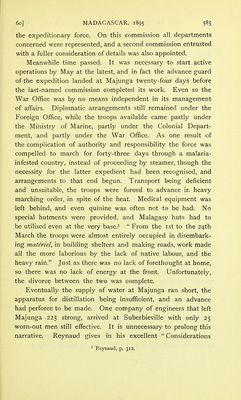
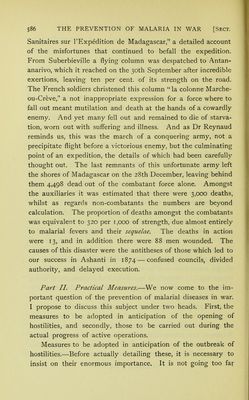
![6o] MADAGASCAR, 1895 5^5 the expeditionary force. On this commission all departments concerned were represented, and a second commission entrusted with a fuller consideration of details was also appointed. Meanwhile time passed. It was necessary to start active operations by May at the latest, and in fact the advance guard of the expedition landed at Majunga twenty-four days before the last-named commission completed its work. Even so the War Office was by no means independent in its management of affairs. Diplomatic arrangements still remained under the Foreign Office, while the troops available came partly under the Ministry of Marine, partly under the Colonial Depart- ment, and partly under the War Office. As one result of the complication of authority and responsibility the force was compelled to march for forty-three days through a malaria- infested country, instead of proceeding by steamer, though the necessity for the latter expedient had been recognised, and arrangements to that end begun. Transport being deficient and unsuitable, the troops were forced to advance ii: heavy marching order, in spite of the heat. Medical equipment was left behind, and even quinine was often not to be had. No special hutments were provided, and Malagasy huts had to be utilised even at the very base.1 From the 1st to the 24th March the troops were almost entirely occupied in disembark- ing materiel, in building shelters and making roads, work made all the more laborious by the lack of native labour, and the heavy rain. Just as there was no lack of forethought at home, so there was no lack of energy at the front. Unfortunately, the divorce between the two was complete. Eventually the supply of water at Majunga ran short, the apparatus for distillation being insufficient, and an advance had perforce to be made. One company of engineers that left Majunga 225 strong, arrived at Suberbieville with only 25 worn-out men still effective. It is unnecessary to prolong this narrative, Reynaud gives in his excellent Considerations](https://iiif.wellcomecollection.org/image/b21351600_0657.jp2/full/800%2C/0/default.jpg)