Fleming's text-book of operative veterinary surgery. Vol. 1 / edited by J. MacQueen.
- George Fleming
- Date:
- 1903
Licence: In copyright
Credit: Fleming's text-book of operative veterinary surgery. Vol. 1 / edited by J. MacQueen. Source: Wellcome Collection.
300/770 page 280
![Consecutive Treatment.—This will vary with circumstances connected with the nature of the disease or accident for which trepanation was necessary. If it is required to have the wound healed as rapidly as possible after the operation, as is generally the case with regard to the removal of hydatids or fractured ]>ieces of bone, or elevation of depressed bones, the borders of the skin are brought together, a piece of carbolized lint is placed over the wound, and over this some pledgets of carbolized tow. These are retained by a long bandage two or three inches in width, which is passed in figure-of-8 fashion around the head, in- cluding the lower jaw and each side of the neck, and the ends secured by pins or sewing, the whole being covered, if necessary, by a light hood or head bandage (Figs. 187, 189). After trepanation the facial sinuses should be washed out daily with a warm antiseptic solution, until foetor and discharge have disappeared. For irrigation purposes Higginson’s syringe, or an enema pump, will be found very convenient. To keep the sinuses open for some time the apertures may be filled with a firm pledget of tow or linen, or (which is best) a rubber-cork may be used. When the openings are to be closed, the plugs or corks should be discontinued.](https://iiif.wellcomecollection.org/image/b28123840_0300.jp2/full/800%2C/0/default.jpg)
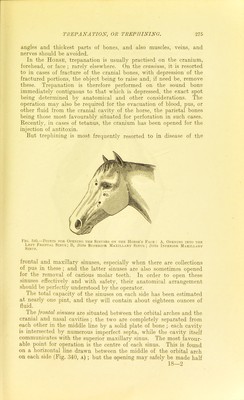
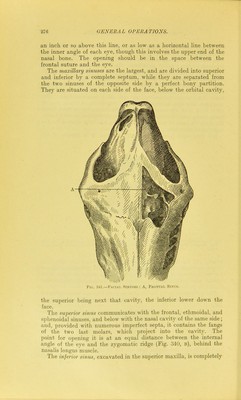


 No text description is available for this image
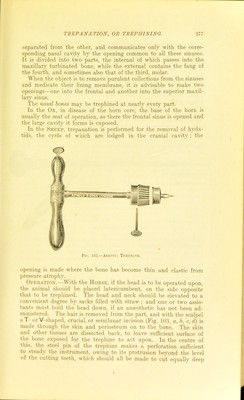
 No text description is available for this image
 No text description is available for this image