Outlines of comparative anatomy of vertebrates / by J.S. Kingsley.
- John Sterling Kingsley
- Date:
- [1917], ©1917
Licence: Public Domain Mark
Credit: Outlines of comparative anatomy of vertebrates / by J.S. Kingsley. Source: Wellcome Collection.
376/468 (page 364)
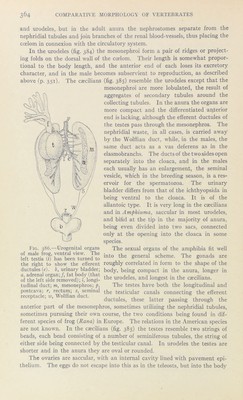
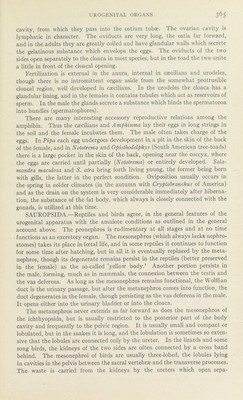
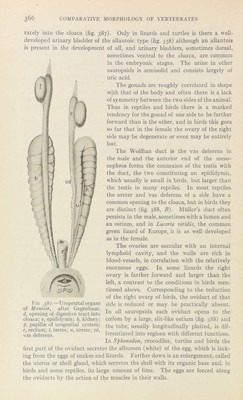
![and urodeles, but in the adult anura the nephrostomes separate from the nephridial tubules and join branches of the renal blood-vessels, thus placing the coelom in connexion with the circulatory system. In the urodeles (fig. 384) the mesonephroi form a pair of ridges or project- ing folds on the dorsal wall of the coelom. Their length is somewhat propor- tional to the body length, and the anterior end of each loses its excretory character, and in the male becomes subservient to reproduction, as described above (p. 351). The caecilians (fig. 385) resemble the urodeles except that the mesonephroi are more lobulated, the result of aggregates of secondary tubules around the collecting tubules. In the anura the organs are more compact and the differentiated anterior end is lacking, although the efferent ductules of the testes pass through the mesonephros. The nephridial waste, in all cases, is carried away' by the Wolffian duct, while, in the males, the same duct acts as a vas deferens as in the elasmobranchs. The ducts of the two sides open separately into the cloaca, and in the males each usually has an enlargement, the seminal vesicle, which in the breeding season, is a res- ervoir for the spermatozoa. The urinary bladder differs from that of the ichthvopsida in being ventral to the cloaca. It is of the allantoic type. It is very long in the caecilians and in Amphinma, saccular in most urodeles, and bifid at the tip in the majority of anura, being even divided into two sacs, connected only at the opening into the cloaca in some species. Fig. 386.—Urogenital organs The sexual organs of the amphibia fit well °e'ftmtetifsr(f)’ hStenZmed1to int0 the *eneral scheme. The gonads are the right to show the efferent roughly correlated in form to the shape of the ductules (e). b, urinary bladder; body, being compact in the anura, longer in of the left side removed); l, longi- the urodeles, and longest m the caecilians. tudinal duct; m, mesonephros; p, The testes have both the longitudinal and postcava; r, rectum; s, seminal £]ie testicular canals connecting the efferent receptacle; w, Wolffian duct. , , , , . ductules, these latter passing through the anterior part of the mesonephros, sometimes utilizing the nephridial tubules, sometimes pursuing their own course, the two conditions being found in dif- ferent species of frog {Rand) in Europe. The relations in the American species are not known. In the caecilians (fig. 385) the testes resemble two strings of beads, each bead consisting of a number of seminiferous tubules, the string of either side being connected by the testicular canal. In urodeles the testes are shorter and in the anura they are oval or rounded. The ovaries are saccular, with an internal cavity lined with pavement epi- thelium. The eggs do not escape into this as in the teleosts, but into the body](https://iiif.wellcomecollection.org/image/b29821502_0376.jp2/full/800%2C/0/default.jpg)