Contributions towards the history of caproic and œnanthylic acids / by J.S. Brazier and G. Grossleth.
- Brazier, James S. (James Smith)
- Date:
- [1851?]
Licence: Public Domain Mark
Credit: Contributions towards the history of caproic and œnanthylic acids / by J.S. Brazier and G. Grossleth. Source: Wellcome Collection.
1/20
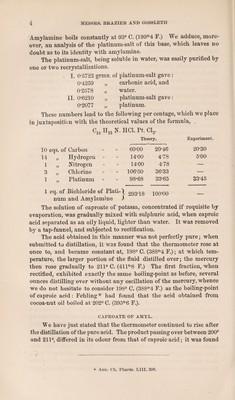
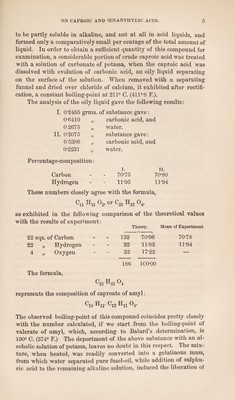
![CONTRIBUTIONS TOWARDS THE HISTORY OF CAPROIC AND (ENANTHYLIC ACIDS. [READ BEFORE THE CHEMICAL SOCIETY OF LONDON.] By Messrs. J. S. BRAZIER, F.C.S. and G. GOSSLETH, Of the Royal College of Chemistry. The leading notions, which begin to elucidate the vast number of observations collected in the department of organic chemistry, have been acquired in the careful study of a comparatively limited number of groups of analogous substances. The investigation of a series of bodies closely allied to each other in their composition and properties, and a comparison of their composition and properties, im¬ parted to the results obtained a degree of interest, which could not have been possibly claimed by the most accurate and minute exami¬ nation of an isolated compound. Among the groups of substances, the study of which has thus most materially assisted in the elaboration of our theoretical views, the series of acids, usually called fatty acids, appears in the first rank. This series, commencing with formic acid, the simplest of all organic acids, and terminating with an acid of so high an equivalent as me- lissic acid, discovered by Mr. Brodie, is at once distinguished by the definite character of its members, by the extent to which it is repre¬ sented by well-investigated terms, and by the variety of sources, be¬ longing to almost all the various departments of organic chemistry from which these terms have been derived. Descending from the alcohols by way of the aldehydes, and connected with the former group in another manner by the nitriles, again related in its deriva¬ tives with marsh-gas and its homologues, as well as with the increas¬ ing family of acetones, the history of this group, when traced in its various ramifications, extends over a field on which we meet with almost all the compounds essentially concerned in the progress of chemical science. A](https://iiif.wellcomecollection.org/image/b30560743_0001.jp2/full/800%2C/0/default.jpg)