Licence: Public Domain Mark
Credit: Heart-beat and pulse-wave / by C.S. Roy and J.G. Adami. Source: Wellcome Collection.
Provider: This material has been provided by the Royal College of Physicians of Edinburgh. The original may be consulted at the Royal College of Physicians of Edinburgh.
74/88 (page 20)
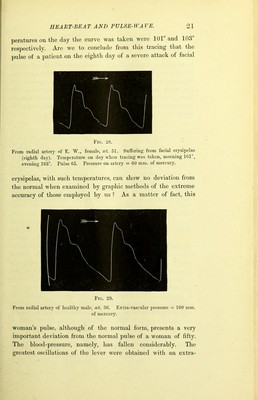
![BY C. S. ROY, M.D , F.R.S., Professor of Pathology, AND J. G. ADAMI, M.A., M.B., Demonstrator of Pathology, in the University of Cambridge. [From the Cambridge Pathological Laboratory.'] SECTION VII.—Continued. It would in many ways be convenient were it possible from the characters of a sphygmographic curve to say at a glance what, if anything, was the matter with the person from whom it was taken. This however cannot by any means always be done, and we cannot help thinking that much of the disfavour into which sphygmographic studies have fallen is due to the fact, that the interpretation of the curves obtained is by no means so simple as is usually believed and taught. There can be no doubt that information of the greatest practical value is obtainable by the application of the graphic method to the pulse, but this can only be the case if the curves be correctly interpreted—a matter which, although often easy enough, is sometimes by no means simple on mere inspection of the tracing. As an illustration of this we may refer to Fig. 28, taken from the radialis dext. of E. W., a female, set. 51. This tracing at first sight seems a typically normal one, and appears to differ in no noteworthy particular from Fig. 29, which was taken from one of ourselves. And yet the first of these was obtained from a patient with facial erysipelas, whose morning and evening tern-](https://iiif.wellcomecollection.org/image/b21908515_0076.jp2/full/800%2C/0/default.jpg)