Volume 1
The mathematical principles of natural philosophy / by Sir Isaac Newton; translated into English by Andrew Motte: to which are added, Newtonʼs System of the world; a short comment on and defense of, the Principia, by William Emerson; with the laws of the moonʼs motion according to gravity, by John Machin.
- Newton, Isaac, 1642-1727. Principia. English
- Date:
- 1819
Licence: Public Domain Mark
Credit: The mathematical principles of natural philosophy / by Sir Isaac Newton; translated into English by Andrew Motte: to which are added, Newtonʼs System of the world; a short comment on and defense of, the Principia, by William Emerson; with the laws of the moonʼs motion according to gravity, by John Machin. Source: Wellcome Collection.
11/384 page 5
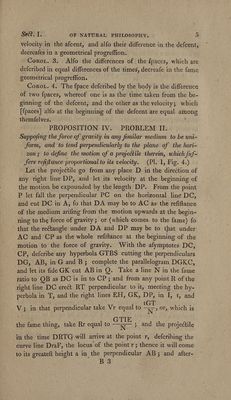
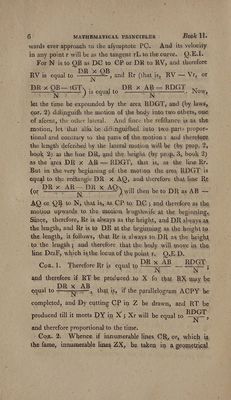
![velocity in the afcent, and alfo their difference in the defcent, decreafes in a geometrical progreffion. Conor. 3. Alfo the differences of the fpaces, which are defcribed in equal differences of the times, decreafe in the fame geometrical progreffion. Corot. 4. The fpace defcribed by the body is the difference of two fpaces, whereof one is as the time taken from the be- ginning of the defcent, and the other as the velocity; which . [fpaces] alfo at the EE of the defcent are equal atone themfelves. PROPOSITION IV. PROBLEM II. Suppofing the force of gravity in any fimilar medium to be uni- form, and to tend perpendicularly to the plane of the hori- zon; to define the motion of a projectile therein, which fuf- fers refiftance proportional to its velocity. (Pl. 1, Fig. 4.) Let the projectile go from any place D in the direction of any right line DP, and let its velocity at the beginning of the motion be expounded by the length DP. From the point P let fall the perpendicular PC on the horizontal line DC, and cut DC in A, fo that DA may be to AC as the refiftance of the medium arifing from the motion upwards at the begin- ning to the force of gravity ; or (which comes. to the fame) fo that the re&angle under DA and DP may be to that under AC and CP as the whole refiftance at the beginning of the motion to the force of gravity. With the afymptotes DC, CP, defcribe any hyperbola GTBS cutting the perpendiculars DG, AB, in G and B ; complete the parallelogram DGKC, and let its fide GK cut ABin Q. Take a line N in the fame ratio to OB as DC is in to CP ; and from any point R of the right line DC erect RT perpendicular to it, meeting the hy- perbola in T, and the right lines EH, GK, DP, in I, t, and V; in that perpendicular take Vr equal to P or, which is GTIE AS the fame thing, take Rr equal to NO? and the projectile in the time DRTG will arrive at the point r, defcribing the curve line DraF, the locus of the point r ; thence it will come to its greateft height a in the perpendicular AB; and after- | qe B3](https://iiif.wellcomecollection.org/image/b29340007_0001_0011.jp2/full/800%2C/0/default.jpg)
 No text description is available for this image
 No text description is available for this image
 No text description is available for this image