Experimental rickets : the effect of cereals and their interaction with other factors of diet and environment in producing rickets / by Edward Mellanby.
- Edward Mellanby
- Date:
- 1925
Licence: In copyright
Credit: Experimental rickets : the effect of cereals and their interaction with other factors of diet and environment in producing rickets / by Edward Mellanby. Source: Wellcome Collection.
5/106 page 5
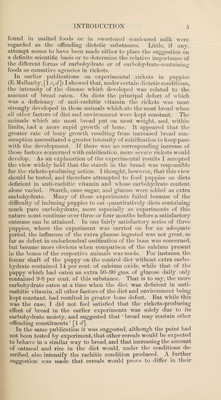
![found in malted foods or in sweetened condensed milk were regarded as the offending dietetic substances. Little, if any, attempt seems to have been made either to place the suggestion on a definite scientific basis or to determine the relative importance of the different forms of carbohydrate or of carbohydrate-containing foods as causative agencies in rickets. In earlier publications on experimental rickets in puppies (E.Mellanby, [1 c, cl]) I showed that, under certain dietetic conditions, the intensity of the disease which developed was related to the amount of bread eaten. On diets the principal defect of which was a deficiency of anti-rachitic vitamin the rickets was most strongly developed in those animals which ate the most bread when all other factors of diet and environment were kept constant. The animals which ate most bread put on most weight, and, within limits, had a more rapid growth of bone. It appeared that the greater rate of bony growth resulting from increased bread con¬ sumption necessitated a greater intensity of calcification to keep pace with the development. If there was no corresponding increase of those factors concerned with calcification, more severe rickets would develop. As an explanation of the experimental results I accepted the view widely held that the starch in the bread was responsible for the rickets-producing action. I thought, however, that this view should be tested, and therefore attempted to feed puppies on diets deficient in anti-rachitic vitamin and whose carbohydrate content alone varied. Starch, cane sugar, and glucose were added as extra carbohydrate. Many of these experiments failed because of the difficulty of inducing puppies to eat quantitatively diets containing much pure carbohydrate, more especially as experiments of this nature must continue over three or four months before a satisfactory outcome can be attained. In one fairly satisfactory series of three puppies, where the experiment was carried on for an adequate period, the influence of the extra glucose ingested was not great, so far as defect in endochondral ossification of the bone was concerned, but became more obvious when comparison of the calcium present in the bones of the respective animals was made. For instance, the femur shaft of the puppy on the control diet without extra carbo¬ hydrate contained 14 per cent, of calcium oxide, while that of the puppy which had eaten an extra 50-90 gms. of glucose daily only contained 9-6 per cent, of this substance. That is to say, the more carbohydrate eaten at a time when the diet was deficient in anti¬ rachitic vitamin, all other factors of the diet and environment being kept constant, had resulted in greater bone defect. But while this was the case, I did not feel satisfied that the rickets-producing effect of bread in the earlier experiments was solely due to its carbohydrate moiety, and suggested that ‘ bread may contain other offending constituents ’ [1 d]. In the same publication it was suggested, although the point had not been tested by experiment, that other cereals would be expected to behave in a similar way to bread, and that increasing the amount of oatmeal and rice in the diet would, under the conditions de¬ scribed, also intensify the rachitic condition produced. A further suggestion was made that cereals would prove to differ in their](https://iiif.wellcomecollection.org/image/b30624988_0005.jp2/full/800%2C/0/default.jpg)