On the origin and development of the pulps and sacs of the human teeth / by John Goodsir.
- Date:
- [1839?]
Licence: Public Domain Mark
Credit: On the origin and development of the pulps and sacs of the human teeth / by John Goodsir. Source: Wellcome Collection.
Provider: This material has been provided by the Royal College of Physicians of Edinburgh. The original may be consulted at the Royal College of Physicians of Edinburgh.
16/38 page 16
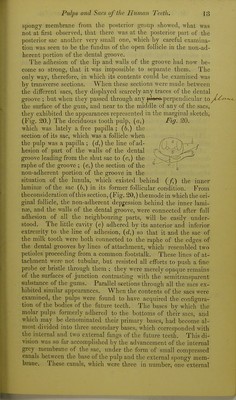
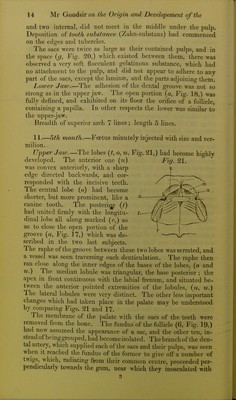
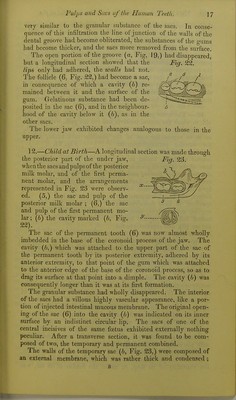
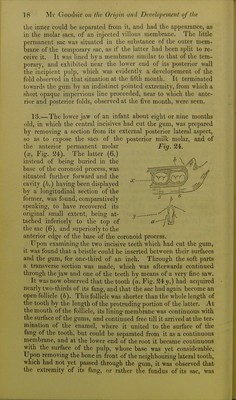
![dicidar ramuscules proceeded as in the case of a pulp with a ])ri- luary base. The arterial net-work, which was formed in the external spongy membrane by the inosculation of these vessels with those proceed- ing from the gums, transmitted sinall branches which ramified witli such minuteness in the substance, and on the surface of that por- tion of the gray membrane to which the granular matter adhered that, when the latter was removed, the former appeared to the nak- ed eye a mass of vermilion, but under a one-fourth of an inch lens exhibited a net-w^ork of the most minute injection. No injected vessel could be seen in the gi-anular substance.* The main dental twig after giving off all these branches, arrived at the base or secondary bases of the pulp, and immediately divided into many branches, which ramified in a contorted flattened position, be- tween the base or bases of the pulp and the membrane of the sac. From these, smaller ramifications were transmitted into the sub- stance of the pulp, which ramified in considerable numbers in the centre of its mass, but scarcely at all near its surface or on its membrane, except in the neighbourhood of, and at the point where, deposition of tooth substance had commenced, immediately be- neath which the vascularity was intense, both in the substance under, and on the surface a little beyond, the edge of the scale.f This surrounding vascularity had the appearance of a zone, and was situated in the substance, and on the surface of an elevated portion of the pulp, which surrounded the scale of tooth substance. The granular substance in contact with the tooth substance and its border had begun to be absorbed, and had consequently be- come thinner in that situation than elsewhere, allowing the subja- cent vascularity to appear through it. No vessel could be de- tected in the granular substance to account for the absorption of its inner surface. The ten little cavities had undergone no change, except that the two or four anterior had become rather longer, and were si- tuated farther from the surface of the gyeovo, so as to be placed rather behind than below the sacs. The anterior cavity, in parti- cular, although its walls were still in contact, and required to be se- parated by the needles under water to see its interior, had become pear-shaped. The fundus or portion farthest from the gum exhibit- ed on its floor a fold, which lay in the direction of the edge of the future permanent tooth, and near its apex there were two Other mmute folds, one on the anterior Avail, the other on the posterior. Beyond this the cavity tenninated in an opaque im- pervious line, which soon disappeared. The substance of the gums had become infiltrated with a quantity of gelatinous matter ' Bluke, Kssay on the Structure and formation of the Teeth, p. 4. t Serres, Essai sur I'Anatomie ct la Phjsiologie dcs Dents, p. 20.](https://iiif.wellcomecollection.org/image/b21955451_0018.jp2/full/800%2C/0/default.jpg)