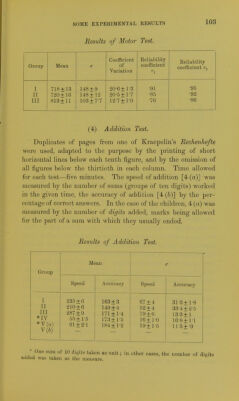
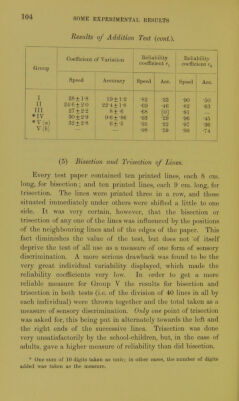
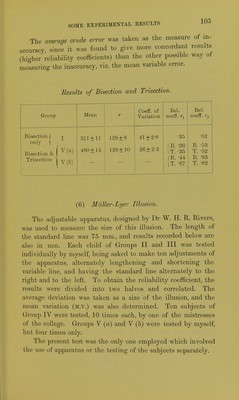
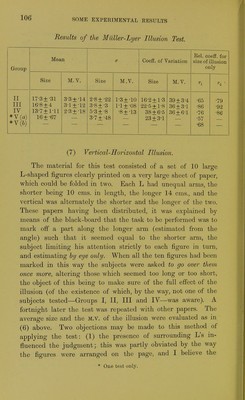
The essentials of mental measurement / by William Brown.
- Brown, William, 1811-
- Date:
- 1911
Licence: In copyright
Credit: The essentials of mental measurement / by William Brown. Source: Wellcome Collection.
Provider: This material has been provided by King’s College London. The original may be consulted at King’s College London.
119/172 (page 107)
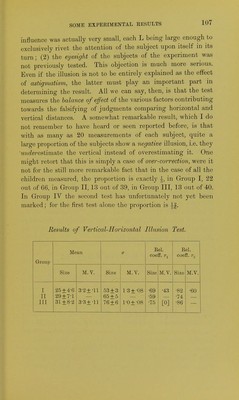
![influence was actually very small, each L being large enough to exclusively rivet the attention of the subject upon itself in its turn; (2) the eyesight of the subjects of the experiment was not previously tested. This objection is much more serious. Even if the illusion is not to be entirely explained as the effect of astigmatism, the latter must play an important part in determining the result. All we can say, then, is that the test measures the balance of effect of the various factors contributing towards the falsifying of judgments comparing horizontal and vertical distances. A somewhat remarkable result, which I do not remember to have heard or seen reported before, is that with as many as 20 measurements of each subject, quite a large proportion of the subjects show a negative illusion, i.e. they ■jMifZerestimate the vertical instead of overestimating it. One might retort that this is simply a case of ovei^-correction, were it not for the still more remarkable fact that in the case of all the children measured, the proportion is exactly ^, in Group I, 22 out of 66, in Group II, 13 out of 39, in Group III, 13 out of 40. In Group IV the second test has unfortunately not yet been marked; for the first test alone the proportion is Results of Vertical-Horizontal Illusion Test. Group Mean Eel. coefif. rj Eel. coefif. Size M. V. Size M.V. Size M.V. Size M.V. I II III 25 + 4-6 29 + 7-1 31+8-2 3-2 ±-11 3-3 ±-11 53 + 3 65 + 5 76 + 6 1-3 ±-08 1-0 ±-08 •69 •59 •75 •43 [0] •82 •74 •86 •60](https://iiif.wellcomecollection.org/image/b21296169_0119.jp2/full/800%2C/0/default.jpg)