The essentials of mental measurement / by William Brown.
- Brown, William, 1811-
- Date:
- 1911
Licence: In copyright
Credit: The essentials of mental measurement / by William Brown. Source: Wellcome Collection.
Provider: This material has been provided by King’s College London. The original may be consulted at King’s College London.
123/172 (page 111)
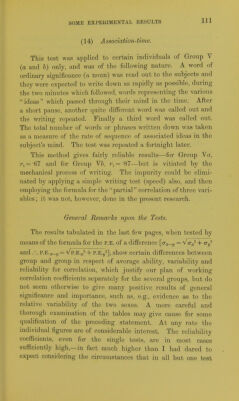
![(14) Association-time. This test was applied to certain individuals of Group V (a and h) only, and was of the following nature. A word of ordinary significance (a noun) was read out to the subjects and they were expected to write down as rapidly as possible, during the two minutes which followed, words representing the various ideas which passed through their mind in the time. After a short pause, another quite different word was called out and the writing repeated. Finally a third word was called out. The total number of words or phrases written down was taken as a measure of the rate of sequence of associated ideas in the subject's mind. The test was repeated a fortnight later. This method gives fairly reliable results—for Group Ya, ri = 67 and for Group Yb, = '87—but is vitiated by the mechanical process of wi-iting. The impurity could be elimi- nated by applying a simple writing test (speed) also, and then employing the formula for the partial correlation of three vari- ables ; it was not, however, done in the present research. General Remarks upon the Tests. The results tabulated in the last few pages, when tested by means of the formula for the P.E. of a difference [a-x-y — '^a^-V and .•. p.E.a;_2/= Vp.E.a;^ 4- P.E./], show certain differences between group and group in respect of average ability, variability and reliability for correlation, which justify our plan of working correlation coefficients separately for the several groups, but do not seem otherwise to give many positive results of general significance and importance, such as, e.g., evidence as to the relative variability of the two sexes. A more careful and thorough examination of the tables may give cause for some qualification of the preceding statement. At any rate the individual figures are of considerable interest. The reliability coefficients, even for the single tests, are in most cases sufficiently high,—in fact much higher than I had dared to expect considering the circumstances that in all but one test](https://iiif.wellcomecollection.org/image/b21296169_0123.jp2/full/800%2C/0/default.jpg)