The essentials of mental measurement / by William Brown.
- Brown, William, 1811-
- Date:
- 1911
Licence: In copyright
Credit: The essentials of mental measurement / by William Brown. Source: Wellcome Collection.
Provider: This material has been provided by King’s College London. The original may be consulted at King’s College London.
124/172 (page 112)
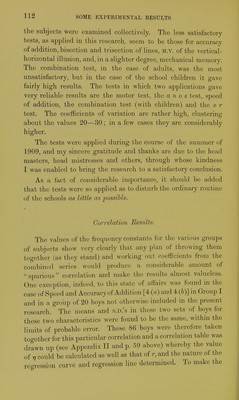
![the subjects were examined collectively. The less satisfactory tests, as applied in this research, seem to be those for accuracy of addition, bisection and trisection of lines, m.v. of the vertical- horizontal illusion, and, in a slighter degree, mechanical memory. The combination test, in the case of adults, was the most unsatisfactory, but in the case of the school children it gave fairly high results. The tests in which two applications gave very reliable results are the motor test, the a n o s test, speed of addition, the combination test (with children) and the e r test. The coefficients of variation are rather high, clustering about the values 20—30; in a few cases they are considerably higher. The tests were applied during the course of the summer of 1909, and my sincere gratitude and thanks are due to the head masters, head mistresses and others, through whose kindness I was enabled to bring the research to a satisfactory conclusion. As a fact of considerable importance, it should be added that the tests were so applied as to disturb the ordinary routine of the schools as little as possible. Correlation Results. The values of the frequency constants for the various groups of subjects show very clearly that any plan of throwing them together (as they stand) and working out coefficients from the combined series would produce a considerable amount of spurious correlation and make the results almost valueless. One exception, indeed, to this state of affairs was found in the case of Speed and Accuracy of Addition [4 (a) and 4 (b)] in Group I and in a group of 20 boys not otherwise included in the present research. The means and s.D.'s in these two sets of boys for these two characteristics were found to be the same, within the limits of probable error. These 86 boys were therefore taken together for this particular correlation and a correlation table was drawn up (see Appendix II and p. 59 above) whereby the value of V could be calculated as well as that of r, and the nature of the regression curve and regression line determined. To make the](https://iiif.wellcomecollection.org/image/b21296169_0124.jp2/full/800%2C/0/default.jpg)