The essentials of mental measurement / by William Brown.
- Brown, William, 1811-
- Date:
- 1911
Licence: In copyright
Credit: The essentials of mental measurement / by William Brown. Source: Wellcome Collection.
Provider: This material has been provided by King’s College London. The original may be consulted at King’s College London.
67/172 (page 55)
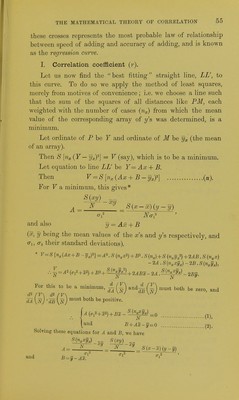
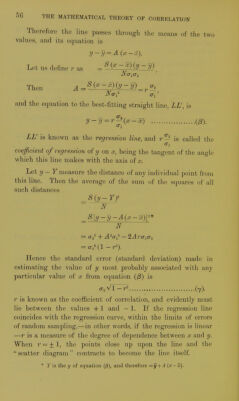
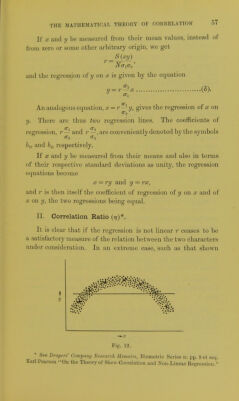
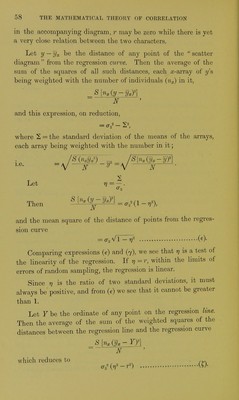
![these crosses represents the most probable law of relationship between speed of adding and accuracy of adding, and is known as the regression curve. I. Correlation coefficient (r). Let us now find the best fitting straight line, LL', to this curve. To do so we apply the method of least squares, merely from motives of convenience; i.e. we choose a line such that the sum of the squares of all distances like PM, each weighted with the number of cases {n^^ from which the mean value of the corresponding array of y's was determined, is a minimum. Let ordinate of P be F and ordinate of M be (the mean of an array). Then >S {wj, (F— y^Y] = V (say), which is to be a minimum. Let equation to line LL' be F= Ax + B. Then V = S{n^{Aw + B-%y} («). For V a minimum, this gives* S(a;y) _ A=JL _S{x-x)(y-y) cr,' No-,' and also y = Ax + B {x, y being the mean values of the x's and y's respectively, and o-j, 0-2 their standard deviations). * V=S{n,,{Ax + B~ y^)^} =A\S (n^x^) +B^.S(nj + S {n^y/) + 2AB.S(n^x) -2A.S{n.,xy^)-2B.S(n^y^), .-. ^ = 42 + 52) + £2 + + 2ABX-2A. ^h^) _ 2By. For this to be a minimum, —(-^ ^ <^ ^fv^ d2/F '^^^ dA \n) 'dB\N) positive. (^) ^^^ ^® and U(<ri2 + 52) + j3j_^i!^)^0 ^^^^ [and B + Ax-y = 0 (2). Solving these equations for A and B, we have S(xy)](https://iiif.wellcomecollection.org/image/b21296169_0067.jp2/full/800%2C/0/default.jpg)