The essentials of mental measurement / by William Brown.
- Brown, William, 1811-
- Date:
- 1911
Licence: In copyright
Credit: The essentials of mental measurement / by William Brown. Source: Wellcome Collection.
Provider: This material has been provided by King’s College London. The original may be consulted at King’s College London.
68/172 (page 56)
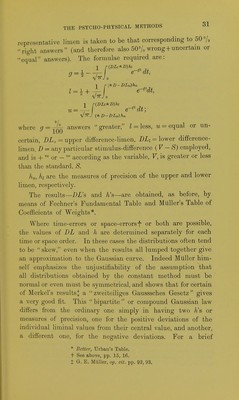
![5G Therefore the line passes through the means of the two values, and its equation is y-y = A{x-x). Let us define r as = ^(^-^)(3/-^) Then and the equation to the best-fitting straight line, LL\ is y-y = r'^{x-x) (^). LL' is known as the regression line, and r — is called the coefficient of regression of y on a;, being the tangent of the angle which this line makes with the axis of x. Let y- F measure the distance of any individual point from this line. Then the average of the sum of the squares of all such distances ^ 8{y-Yf N ' ' _S{y-y -A (x - x)\-* - ]v = 0-2^ + AW - 2Ara;a2 = a,^l-r-). Hence the standard error (standard deviation) made in estimating the value of y most probably associated with any particular value of x from equation (/S) is O-aVl-r^ (ry). r is known as the coefficient of correlation, and evidently must lie between the values +1 and — 1. If the regression line coincides with the regression curve, within the limits of errors of random sampling,—in other words, if the regression is linear —r is a measure of the degree of dependence between x and y. When r = + 1, the points close up upon the line and the scatter diagram contracts to become the line itself. * Y is the y of equation (/3), and therefore = y + A (x-x).](https://iiif.wellcomecollection.org/image/b21296169_0068.jp2/full/800%2C/0/default.jpg)