The essentials of mental measurement / by William Brown.
- Brown, William, 1811-
- Date:
- 1911
Licence: In copyright
Credit: The essentials of mental measurement / by William Brown. Source: Wellcome Collection.
Provider: This material has been provided by King’s College London. The original may be consulted at King’s College London.
87/172 (page 75)
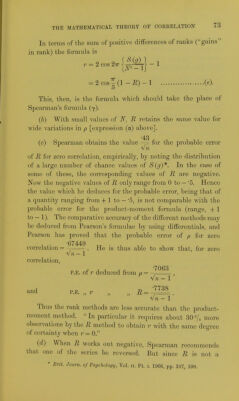
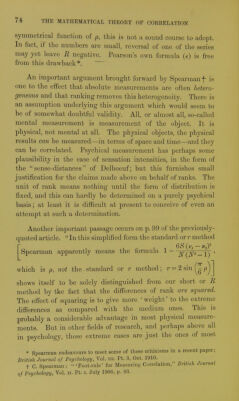
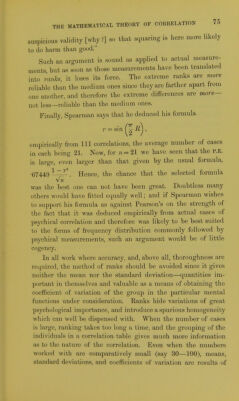
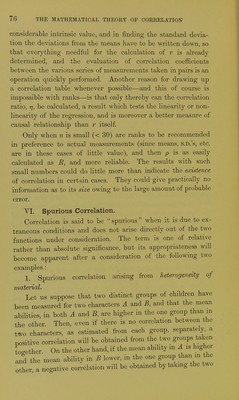
![suspicious validity [why ?] so that squaring is here more likely to do harm than good. Such an argument is sound as applied to actual measure- ments, but as soon as those measurements have been translated into ranks, it loses its force. The extreme ranks are viore reliable than the medium ones since they are farther apart from one another, and therefore the extreme differences are more— not less—reliable than the medium ones. Finally, Spearman says that he deduced his formula = sin (I R empirically from 111 correlations, the average number of cases in each being 21. Now, for ?i= 21 we have seen that the P.E. is large, even larger than that given by the usual formula, 1 2 •67449 LZJL . Hence, the chance that the selected formula 'J 71 was the best one can not have been gi*eat. Doubtless many others would have fitted equally well; and if Spearman wishes to support his formula as against Pearson's on the strength of the fact that it was deduced empirically from actual cases of psychical correlation and therefore was likely to be best suited to the forms of frequency distribution commonly followed by psychical measurements, such an argument would be of little cogency. In all work where accuracy, and, above all, thoroughness are required, the method of ranks should be avoided since it gives neither the mean nor the standard deviation—quantities im- portant in themselves and valuable as a means of obtaining the coefficient of variation of the group in the particular mental functions under consideration. Ranks hide variations of great psychological importance, and introduce a spurious homogeneity which can well be dispensed with. When the number of cases is large, ranking takes too long a time, and the grouping of the individuals in a correlation table gives much more information as to the nature of the correlation. Even when the numbers worked with are comparatively small (say 30—100), means, standard deviations, and coefficients of variation are results of](https://iiif.wellcomecollection.org/image/b21296169_0087.jp2/full/800%2C/0/default.jpg)