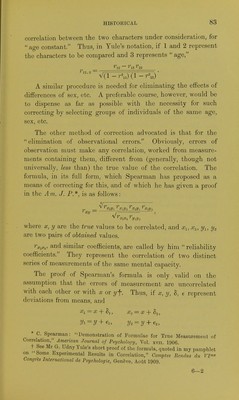
The essentials of mental measurement / by William Brown.
- Brown, William, 1811-
- Date:
- 1911
Licence: In copyright
Credit: The essentials of mental measurement / by William Brown. Source: Wellcome Collection.
Provider: This material has been provided by King’s College London. The original may be consulted at King’s College London.
96/172 (page 84)
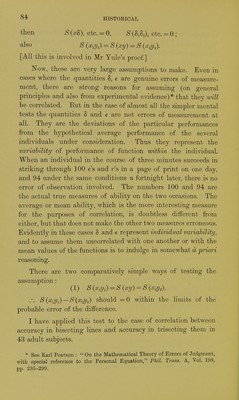
![then S(xB), etc. = 0, S (S,S,), etc. = 0 ; also S {x,y,) = S (xy) = S {x,y,). [All this is involved in Mr Yule's proof.] Now, these are very large assumptions to make. Even in cases where the quantities B, e are genuine errors of measure- ment, there are strong reasons for assuming (on general principles and also from experimental evidence)* that they will be correlated. But in the case of almost all the simpler mental tests the quantities 8 and e are not errors of measurement at all. They are the deviations of the particular performances from the hypothetical average performance of the several individuals under consideration. Thus they represent the variability of performance of function within the individual. When an individual in the course of three minutes succeeds in striking through 100 es and r's in a page of print on one day, and 94 under the same conditions a fortnight later, there is no error of observation involved. The numbers 100 and 94 are the actual true measures of ability on the two occasions. The average or mean ability, which is the more interesting measure for the purposes of correlation, is doubtless different from either, but that does not make the other two measures erroneous. Evidently in these cases S and e represent individual variability, and to assume them uncorrelated with one another or with the mean values of the functions is to indulge in somewhat d ^rtori reasoning. There are two comparatively simple ways of testing the assumption: (1) S (x,y,) = S (xy) = S (x^,), .'. S(x^yi) — S(x^yi) should =0 within the limits of the probable error of the difference. I have applied this test to the case of correlation between accuracy in bisecting lines and accuracy in trisecting them in 43 adult subjects. * See Karl Pearson : On the Mathematical Theory of Errors of Judgment, with special reference to the Personal Equation, Phil. Trans. A, Vol. 198, pp. 235-299.](https://iiif.wellcomecollection.org/image/b21296169_0096.jp2/full/800%2C/0/default.jpg)