History of the Eclectic Medical Institute, Cincinnati, Ohio, 1845-1902 / by Harvey Wickes Felter.
- Harvey Wickes Felter
- Date:
- 1902
Licence: In copyright
Credit: History of the Eclectic Medical Institute, Cincinnati, Ohio, 1845-1902 / by Harvey Wickes Felter. Source: Wellcome Collection.
97/214 (page 93)
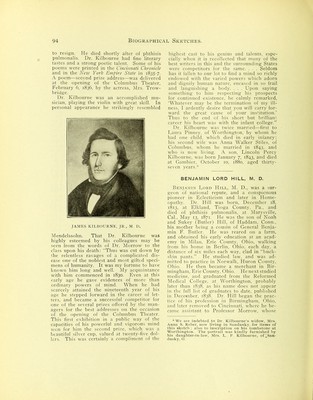
![He studied medicine in Cleveland. Whiie studying medicine (in 1833) he had an attack of cholera, and a second attack in 1850.* In early life Dr. Jones had been a school- teacher, and through such employment had saved enough money to enable him to enter the medical school at Worthington in 1831. from which he graduated in 1833. He then located in Dublin, Ind., a locality that was then practically the backwoods. There he met with a medium degree of success. In 1844 he was associated with Drs. Morrow, Baldridge, and Hill in the Reformed Medical School of Cincinnati, and in 1845 was ap- pointed to the Faculty of the Institute. This position he held for twenty-one years, from 1845 to 1870, barring four years (1852 to 1856), when he was engaged in conducting another school of medicine, which he had founded, the American Medical College of Cincinnati. In 1848 he and Dr. John King were elected secretaries of the first National Eclectic Med- ical Association. In 1871, Dr. Jones was transferred to the honorable position of Emeritus Professor of Materia Medica in the Institute. For twenty-five years he had not practiced medicine, laboring under a loss of vision from a cataract, and failed to keep in touch with the progress of the day through its literature. Complaints that he was far behind the times, and that his teaching was imperfect, were continually flowing in upon the college management, until, with no feel- ing of ill-will, he was requested to give way to an active practitioner. Under the impres- sion that he had been promised a professor- ship in perpetuity, he entered suit for six thou- sand dollars against Dr. Scudder, which met with an adverse decision in the Superior Court of Cincinnati. He was succeeded by Professor Locke, who still honors the chair of Materia Medica. Dr. Jones then removed to Urbana, and having previously made good investments in Cincinnati property, became quite wealthy, being worth at his death about $400,000. In conjunction with Dr. John M. Scudder, Dr. Jones prepared the American Eclec- tic Materia Medica and Therapeutics.” In the Institute, Dr. Jones taught Surgery, Ob- stetrics, and Practice for a brief period, and Materia Medica, Therapeutics, and Botany for many years. Dr. Jones was twice married, first to Susan A. Hall, of Lysander, N. Y., who died Sep- tember 10, 1875. His second wife was Fannie V. Newlandj of Piqua, Ohio, who died at the ♦See Eclectic] Medical Journal, 1866, «pp. 66!and 68. latter place, September 7, 1881, as a result of railroad injuries. No better idea can be given of the char- acter of Dr. Jones than the sketch by Dr. Scudder, written at the time of the former’s death. It shows how kindly Dr. Scudder could feel toward his antagonists, and par- ticularly to those whose natural pugnacity compelled them to show opposition to him. Of Professor Jones he wrote: “He was a man of strong convictions and strong prejudices, and an earnest teacher. Our old students will recollect how punctual he was to the hour, and how certain he was to make it full sixty minutes; how patiently he would wait to see if the next lecturer would come, and how eagerly he would shoulder the hour if he failed to put in an appearance; how he re- joiced in being able to make a full half day on Thanksgiving, Christmas, and New-Years; how he would dwell on the virtues of Allium Cepa and Nepeta Cataria. And then how he would worry calomel, batting it now hither, now yonder, now up, now down, until one verily believed the devil was dead. When mercury no longer required so much cuffing, he felt sure the times were out of joint. “But our old friend is gone where sin and sorrow, mercury and arsenic will trouble him no longer. We all unite in hoping that he may find a comfortable place and a lasting peace after a life of war. He was not much given to religion, but had a kindly feeling for church-goers and a good sermon. He had a decent respect for the devil, though in his later yeqrs he had little fear of the archenemy —at least not the fear that worketh righteous- ness. And from our knowledge of our old friend, we feel sure that he will hold his own wherever he may find himself.” JAMES KILBOURNE, JR., M. D. Jambs Kilbourne, Jr., M. D.. son of Col- onel James Kilbourne and Cynthia (Goodale) Kilbourne, was born at Worthington, Ohio, April 30, 1815, and died at Columbus, Ohio, May 30, 1845. His early education was that of the common schools, and he graduated in medicine some time previous to 1838 at the Reformed Medical School at Worthington. He began practice with his brother-in-law, Dr. I. G. Jones, of Columbus. When Dr. Morrow opened the Reformed Medical School at Cincinnati, Dr. Kilbourne became, in 1844, Professor of Materia Medica and Therapeutics, filling the chair with great satis- faction, but at the end of one term his health had become so miserable that he was obliged](https://iiif.wellcomecollection.org/image/b24867500_0097.jp2/full/800%2C/0/default.jpg)