The doctor at home, and nurse's guidebook ... / edited by George Black.
- Black, George
- Date:
- 1891
Licence: Public Domain Mark
Credit: The doctor at home, and nurse's guidebook ... / edited by George Black. Source: Wellcome Collection.
139/908 (page 129)
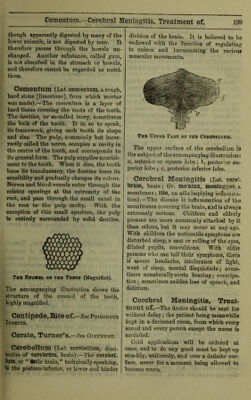
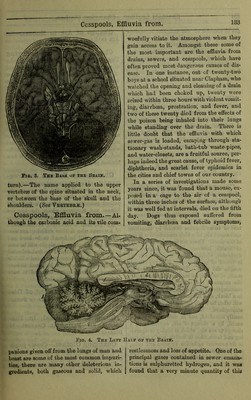
![Cementum.—Cerebral Meningitis, Treatment of. though apparently digested by many of the lower animals, is not digested by man. It therefore passes through the bowels un- changed. Another substance, called gum, is not absorbed in the stomach or bowels, and therefore cannot be regarded as nutri- tious. Cementum {Lat. csementnm, a rough, hard stone [limestone], from which mortar was made).—The cementum is a layer of hard tissue covering the roots of the teeth. The dentine, or so-called ivory, constitutes the bulk of the tooth. It is, so to speak, its framework, giving each tooth its shape and size. The ^pulip, commonly but incor- rectly called the nerve, occupies a cavity in the centre of the tooth, and corresponds to its general form. The pulp supplies nourish- ment to the tooth. When it dies, the tooth loses its translucency, the dentine loses its sensibility and gradually changes its colour. Nerves and blood-vessels enter through the minute openings at the extremity of the root, and pass through the small canal in the root to the pulp cavity. With the exception of this small aperture, the pulp is entirely surrounded by solid dentine. Thb Eirimn ob thb Tbbth (Magnified). The accompanying illustration shows the structure of the enamel of the teeth, highly magnified. Centipede, Bite of,—See Poisonous Insects. Cerate, Turner’s.—Ointment. Cerebellum {Lat cerebellum, dimi- nutive of cerebrum, brain).—The cerebel- lum, or “Iftttle brain,” technically speaking, is the postero-inferior, or lower and hinder division of the brain. It is believed to be endowed with the function of regulating in unison and harmonizing the various muscular movements. Thb Uppbb Fakt ob the Ceeebellum. The upper surface of the cerebellum is the subject of the accompanying illustration; a, an.tei’ior or squai*e lobe ; h, posterior su- perior lobe ; c, posterior inferior lobe. Cerebral Meningitis {Lat. cere'- brum, brain; Or. me'ninx, meninggos, a membrane; itis, an affix implying inflamma- tion).—The disease is inflammation of the membranes covering the brain, and is always extremely serious. Children and elderly persons are more commonly attacked by it than others, but it may occur at any age. With childi’en the noticeable symptoms are disturbed sleep, a cast or rolling of the eyes, dilated pupils, convulsions. With older persons who can tell their symptoms, tlere i^ aei^ere headache, intolerance of light, want of sleep, mental disquietude; some- times unnaturally acute hearing; constipa- tion ; sometimes sudden loss of speech, and delirium. Cerebral Meningitis, Treat- ment of.—The doctor should be sent for without delay; the patient being meanwhile kept in a darkened room, from which every sound and every person except the nurse is excluded. Cold applications will be ordered at once, and to do any good must be kept up steadily, uniformly, and over a definite sur- face, never for a moment being allowed to become warm.](https://iiif.wellcomecollection.org/image/b28082692_0141.jp2/full/800%2C/0/default.jpg)