Report of the Commission appointed to Inquire into the Decrease of the Native Population, with appendices.
- Fiji. Commission appointed to Inquire into the Decrease of the Native Population.
- Date:
- 1896
Licence: Public Domain Mark
Credit: Report of the Commission appointed to Inquire into the Decrease of the Native Population, with appendices. Source: Wellcome Collection.
Provider: This material has been provided by London School of Hygiene & Tropical Medicine Library & Archives Service. The original may be consulted at London School of Hygiene & Tropical Medicine Library & Archives Service.
255/442
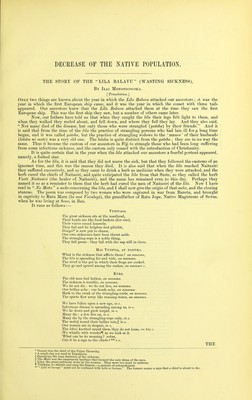
![THE STOET OP THE LILA BALAVU (WASTINQ SICKNESS), By Ilai Motonicocoka. \_Translation,.] Only two things are known about the year in which the Lila Balavu attacked our ancestors ; it was the year in which the first European ship came, and it was the year in which the comet with three tails appeared. Our ancestors knew that the Lila Balavu attacked them at the time they saw the first European ship. This was the first ship they saw, but a number of others came later. Now, our fathers have told us that when they caught the lila their legs felt light to them, and when they walked they reeled about, and fell down, and where they fell they lay. And they also said, Not many died of the disease, but only those who were strangled {jjatebd) by their friends. And it is said that from the time of the lila the practice of strangling persons who had lain ill for ^ long time began, and it was called yateha, but the practice of strangling widows to the ' manes' of their husbands {loloku ni mate) was a very old one. The lolohu is quite distinct from the yateha : they are in no way the same. Thus it became the custom of our ancestors in Fiji to strangle those who had been long suffering from some infectious sickness, and the custom only ceased with the introduction of Christianity. It is quite certain that in the year when the lila attacked our ancestors a fearful portent appeared, namely, a forked star. As for the lila, it is said that they did not nurse the sick, but that they followed the customs of an ignorant time, and this was the reason they died. It is also said that when the lila reached Naitasiri they suffered excessively, and so they came to drink a herb as medicine when they were attacked, and the herb cured the chiefs of Naitasiri, and quite extirpated the lila from that State, so they called the herb Vueti Naitasiri (the healer of Naitasiri), and the name has remained even to this day. Perhaps they named it so as a reminder to them that the herb had cured the men of Naitasiri of the lila. Now I have read in Na Mata a meke concerning the lila, and I shall now give the origin of that meke, and the closing stanzas. The poem was composed by two women who were captured in war from Buretu, and brought in captivity to Ratu Mara (Jco mai Vavalagi), the grandfather of Eatu Jope, Native Magistrate of Serua, when he was living at Soso, in Ban. It runs as follows :— VrNIVASA. The great sickness sits at tlie masthead, Their heads are like food-baskets (for size), Their voices sound hoarsely. They fall and lie helpless and pitiable, Dengei* is now put to shame, Our own sicknesses have been thrust aside. The strangling-rope is a noble thing, They fall prone : they fall with the sap still in them. Mai Vtjnivia, au nanuma. What is the sickness that afflicts them ? au nanuma, The lila is spreading far and wide, au nanuma. The siraf is the pot in which their frogs are cooked. They go and sprawl among the rushes, au nanuma e. KrEA. The old men feel listless, au nanuma. The sickness is terrible, au nanuma. We do not die : we do not live, au nanuma. Our bellies ache : our heads ache, au nanuma. Hark to the creak of the strangling-cords, au nanuma. The spirits flow away Uke running-water, au namima. We have fallen upon a new age, io e. Infectious disease is spreading among us, io e. We lie down and grow torpid, io e. Many die : a few live on, io e. Many die by the strangling-rope only, io e. The malo^ round their bellies rots,J io e. Our women are in despair, io e, The liku\\ knotted round them they do not loose, ra tau e. We whistle with wonderlT as we look at it. What can be its meaning ? uetau, Can it be a sign to the chiefs ? ** e e. THE * Dengei was tlie chief of the Fijian Thearchy. t A small clay pot used in Vanualevu. % Signifying the long duration of the sickness. § The Male was the suspensory bandage that formed the only dress of the men. II Liku, the grass petticoat worn by the women. They were too weak to undress. **;< T^^^' *° ^^istle and snap the fingers,—a gesture of astonishment.](https://iiif.wellcomecollection.org/image/b24399401_0255.jp2/full/800%2C/0/default.jpg)