Report of the Commission appointed to Inquire into the Decrease of the Native Population, with appendices.
- Fiji. Commission appointed to Inquire into the Decrease of the Native Population.
- Date:
- 1896
Licence: Public Domain Mark
Credit: Report of the Commission appointed to Inquire into the Decrease of the Native Population, with appendices. Source: Wellcome Collection.
Provider: This material has been provided by London School of Hygiene & Tropical Medicine Library & Archives Service. The original may be consulted at London School of Hygiene & Tropical Medicine Library & Archives Service.
315/442 (page 37)
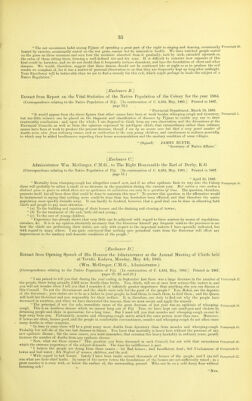
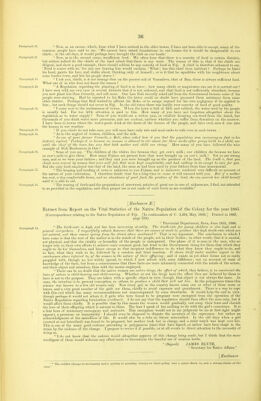
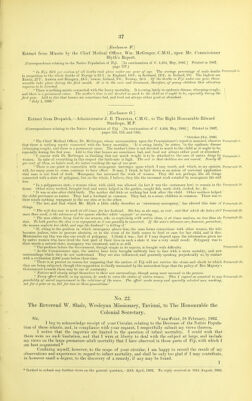
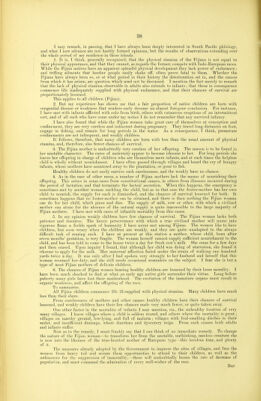
![[Uticlosure F.] Extract from Minute by the Chief Medical Officer, Wm. McGrregor, C.M.G., upon Mr. Commissioner Blyth's Report. (Correspondence relating to tlie Native Population of Fiji. [In continuation of C. 4,434, May, 1885.] Printed in 1887, page 177.) III Fiji, 36'6 pel- centum of all deaths too/c place under one year of age. The average percentage of male deaths Paragraph 3. in proportion to the whole deaths of Europe is 21-1 ; in England, 14-9 ; in Scotland, 12-2 ; in Ireland, 9-6. The lughest are Eussia, 277 ; Austria and Hungary, 24-5 ; lowest, Ireland, 9-6 ; Norway, 10'5. Of the deaths in Fiji under one year, three- sevenths take place during the first month. It is to the care and treatment, therefore, of young children thai attention requires to be directed. There is nothing mystic connected with the heavy mortality. It is owing lately to epidemic disease, whooijing-cough ; I and there is a permaneiit cause. The mother's time is not devoted so much to the child as it ought to he, especially during the ' first year. Add to this that houses are sometimes bad, and food not always either good or abundant. \ July 1, 1886. [Enclosure G.'\ Extract from Despatch,—Administrator J. B. Thurston, C.M.Gr., to The Eight Honourable Edward Stanhope, M.P. (Correspondence relating to the Native Population of Fiji. [In continuation of C. 4,434, May, 1885.] Printed in 1887, pages 154, 155, and 156). October 21st, 1886. The Chief Medical Officer, Dr. McGregor, whose memorandum upon the Commissioner s report is annexed, observes Pai-agraph 4. that there is nothing mystic connected with the heavy mortality. ' It is owing lately,' he states, ' to the epidemic disease (whooping-cough), and there is a permanent cause. The mother's time is not devoted so much to the child as it ought to be, especially during the first year. Add to this that hovises are sometimes bad, and food not always either good or abundant.' I concur with Dr. McGregor in thinking that not much weight is to be attached to the uses of native drugs by Paragi-aijli 5. women. In spite of everything in this resjsect the birth-rate is high. The evil is that children are not reared. Nearly 37 per cent, of them, as before said, die before reaching the age of one year. There is one point in connection with monogamic marriages upon which I may touch, and which, in my opinion, Paragraph 18. will, for many years to come, continue to have effect. It may, I think, be laid down as an axiom of iniiversal application that man is not fond of work. Monogamy has increased the work of women. They did not, perhaps, like all things connected with a state of polygamy, but on the whole, I believe, they like the incessant work entailed by monogamic life still less. In a polygamous state, a woman when with child, was allowed (in fact it was the customary law) to remain in the Paragi'aph 19. house. Other wives worked, brought food and water, lielped in the garden, caught fish, made cloth, cooked, &c., &c. It was so also after child-birth. The mother did little or nothing but look after the child. Other mothers helped the child perchance as nurses. They had a husband in common. They had, in a sense, children in common. There was to their minds nothing repugnant in the one idea or in the other. The law, and that which Mr. Blyth a Little oddly describes as ' missionary-monogamy,' has altered this state of Paragraph 20. things. The wife has now to worTc at all times for her husband. She has, so she says, no rest ; and that -which she hates still Paragraph 21. more than work, is the advances of her spouse whether ivhile ' enciente ' or nursing. The man abhors being tied to one ivoman, tvho in conformity ivith native ideas, is at times unclean, no less than she Paragraph 22. does. To both parties the idea is as repugnant as it can possibly be conceived. If the man's advances are, hotvever, per.nstent, the woman neglects her child, and says the husband ' is killing it.' If, owing to the position in which monogamy places him, the man forms connections with other women, the wife becomes jealous, tries to procure abortion, or in the event of its birth ceases to feed or care for her child, and it dies. Missionaries say this was also one result of polygamy. I think it was ; but if I may depend upon the information given me by native women who have lived the best part of their lives in such a state it was a very small result. Polygamy was to their minds a natural state, monogamy was unnatural, and is so still. The-problem before the Government, tliough simple in its aspects, is fraught with difficulty. Paragraph 23. As the Commissioner says, the natives have been brought suddenly face to face with a stern morality, and new surroundings which they do not understand. They are also influenced, and generally speaking prejudicially so, by contact with a civilisation 2,000 years before their time. There is at present no reason for supposing that the natives of Fiji will not survive the strain and shock to whicli Paragraph 24. they are being subjected, though this supposition is chiefly warranted by the antecedent hope that the policy of Her Majesty's Government towards them may be one of continuity. Natives will slowly admpt themselves to their new surroundings, though many must .succumb in the process. Fvery effort should, in my opinion, be made to raise the status of native tvomen. This I regard as essential to any Paragraph 2.5. possihility of moral improvement in the relations of the sexes. The effort needs money and .specially selected men, working, not for a year or so, but for two or three generations. No. 22. The Eeverend W. Slade, Wesleyan Missionary, Taviuni, to The Honourable the Colonial Secretary. Sir, Vuna f oint, 18 February, 1892. I beg to acknowledge receipt of your Circular, relating to the Decrease of the Native Popula- tion of these islands, and, in compliance with your request, I respectfully submit my views thereon. I notice that the inquiries are limited to the question of infant mortality, I could wish that there were no such limitation, and that 1 were at liberty to deal with the subject at large, and include my views on the large premature adult mortality that I have observed in those parts of Eiji, with which I am best acquainted.* Coufining myself, however, to the scope of your circular, I am happy to record the result of my observations and ex])erience in regard to infant mortality, and shall be only too glad if I may contribute, in however small a degree, to the discovery of a remedy, if any may be found. * Invited to siibmit any further views on the general question,—26th April, 1892. No reply received at 16th August, 1892.](https://iiif.wellcomecollection.org/image/b24399401_0315.jp2/full/800%2C/0/default.jpg)