Report of the Commission appointed to Inquire into the Decrease of the Native Population, with appendices.
- Fiji. Commission appointed to Inquire into the Decrease of the Native Population.
- Date:
- 1896
Licence: Public Domain Mark
Credit: Report of the Commission appointed to Inquire into the Decrease of the Native Population, with appendices. Source: Wellcome Collection.
Provider: This material has been provided by London School of Hygiene & Tropical Medicine Library & Archives Service. The original may be consulted at London School of Hygiene & Tropical Medicine Library & Archives Service.
320/442 (page 42)
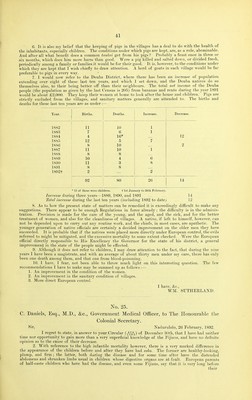
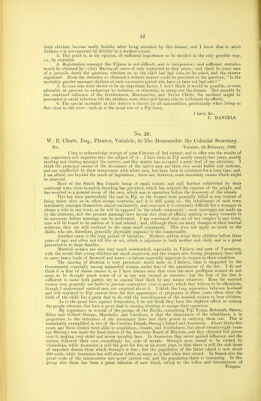
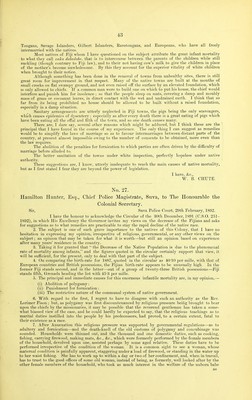
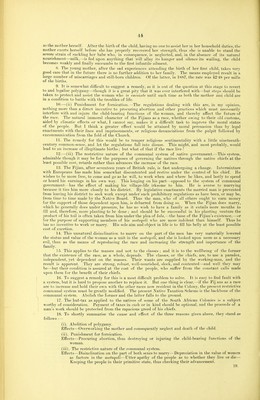
![their children become really healthy after being attacked by this disease; and I know that in adult Indians it is accompanied by debility to a marked extent. 3. This point is, in my opinion, of sufficient importance to be decided in the only possible way, i.e., by statistics. 4. Registration amongst the Fijians is not difficult, and is inexpensive ; and sufficient statistics would be obtained by—(1st) Having all cases of coko registered as they occur; and (2ud) In every case of a juvenile death the question, whether or no the child ha,d had coko, to be asked, and the answer registered. Prom the statistics so obtained a definite answer could be procured to the question, Is the mortality greater amongst children at each successive period who have or have not had colco ? 5. In case coko were shown to be an important factor, I don't think it would be possible, or even advisable, at present, to endeavour by isolation, or otherwise, to stamp out the disease. But possibly by the combined influence of the Grovernment, Missionai-ies, and Native Chiefs, the mothers might be persuaded to avoid infection till the children were older and better able to withstand its effects. 6. The special mortality in this district is shared by all nationalities, particularly when living on flats close to the river—such as is the usual site of a Fiji town. I have, &c., C. DANIELS. No. 26. W. B. Chute, Esq., Planter, Vatulele, to The Honourable the Colonial Secretary. Sir, Vatulele, 20 February, 1892. I beg to acknowledge receipt of your Circular of 3rd instant, and to offer you the results of my experience and inquiries into the subject of it. I have been in Fiji nearly twenty-two years, mostly residing and trading amongst the natives, and this matter has occupied a great deal of my attention. I think the principal causes of the decadence of the native race are their own social habits and customs, and are unaffected by their intercourse with white men, but have been in existence for a long time, and, I am afraid, are beyond the reach of legislation ; there are, however, some secondary causes which might be removed. Most of the South Sea Islands being of small extent, and still further subdivided by their continual wars, close in-and-in breeding has prevailed, which has reduced the stamina of the people, and has resulted in a general deca)^ of the race, which was in operation before the discovery of the islands. This has been particularly the case in Fiji, as the women were generally killed in war instead of being taken alive as in other savage countries, and it is still going on ; the inhabitants of each town intermarry amongst themselves almost exclusively, and even now it is extremely difficult for a stranger to obtain a wife in any town, as he will be opposed by the whole community ; most marriages are made up by the relations, and the present marriage laws favour this state of affairs, making so many consents to be necessary before marriage can be performed. I am convinced that out of ten couples in any town, nine will be found to be natives of it and related ; and, although there are many changes in their marital relations, they are still confined to the same small community. This does not apply so much to the chiefs, who are, therefore, generally physically sujjerior to the commonality. Another cause is the long period of lactation. Mothers seldom wean their children before three years of age, and often not till five or six, which is injurious to both mother and child, and is a great preventative to large families. Married women are also very much overworked, especially in Vitilevu and part of Vanualevu, with the result that young children are much neglected, and the women also during pregnancy have still to carry heavy loads of firewood and water—a labour especially injurious to women in their condition. The causing of abortion is very prevalent; much more so, I believe, than is suspected by the Grovernment, especially among unmarried women, under fear of the punishment of the law. I do not think it is fear of shame causes it, as I have always seen that even the most profligate women do not seem to be thought much worse of or in any way treated as outcasts ; but the fear of the fine is sufficient to make both parties try to conceal their fault by any means whatever. Even the married women very generally use herbs to prevent conce])tion {wai ni yava), which they believe to be efficacious, though I understand medical men are sceptical about it. I think the long separation between husband and wife enjoined by Fiji custom from the first appearance of pregnancy to three years often after the birth of the child, has a great deal to do with the unwillingness of the married women to bear children. As to the penal laws against fornication, I do not think they have the slightest effect in makmg the people virtuous, but have a great deal in causing aboi-tion to escape their operation. My experience m several of the groups of the Pacific, comprising Fiji, Tonga, Eotumah, Samoa, EUice and Grilbert Groups, Marshalls, and Carolines, is that the diminution of the inhabitants is in proportion to the strictness of the missionary laws and their power in carrying them out. This is remarkably exemplified in two of the Caroline Islands, Strong's Island and Ascension. About thirty-five years ago these islands were alike in population, climate, and fruitfulness, but about twenty-eight years ago Strong's was made the head station of the American Board of Missions, and they obtained full power over it, making very strict and severe morality laws. In Ascension they never gained influence, and the natives followed their own exceedingly lax code of morals. Strong's soon ceased to be visited by whaleships, while Ascension is still the port for five or six every year, so that there is still the risk there of imported disease from which Strong's is free ; but the population of the latter island is now about 200 souls, while Ascension has still about 5,000, as many as it had when first visited. In Samoa also the penal code of the missionaries was never carried out, and the population there is increasing. In this group also there has been a great infusion of new blood, owing to the influx and intermixture of Tongans](https://iiif.wellcomecollection.org/image/b24399401_0320.jp2/full/800%2C/0/default.jpg)