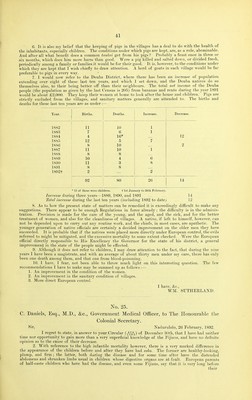
Report of the Commission appointed to Inquire into the Decrease of the Native Population, with appendices.
- Fiji. Commission appointed to Inquire into the Decrease of the Native Population.
- Date:
- 1896
Licence: Public Domain Mark
Credit: Report of the Commission appointed to Inquire into the Decrease of the Native Population, with appendices. Source: Wellcome Collection.
Provider: This material has been provided by London School of Hygiene & Tropical Medicine Library & Archives Service. The original may be consulted at London School of Hygiene & Tropical Medicine Library & Archives Service.
322/442 (page 44)
![as the mother herself. After the birth of the child, having no one to assist her in her household, duties, the mother exerts herself before she has properly recovered her strength, thus she is unable to stand the severe strain of suckling her babe who, in consequence, is neglected, and, in the absence of its natural nourishment—milk,—is fed upon anything that will allay its hunger and silence its wailing, the child becomes weakly and finally succumbs to the first infantile\ii]ment. 8. The young mother, after the sad experiences attending the birth of her first child, takes very good care that in the future there is no further addition to her family. The means employed result in a large number of miscarriages and still-born children. Of the latter, in 1887, the rate was 42-48 per mille of the births. 9. It is somewhat difficult to suggest a remedy, as it is out of the question at this stage to revert to and legalise polygamy—though it is a great pity that it was ever interfered with—but ste])s should be taken to protect and assist the woman who is enceinte until such time as both the mother and child are in a condition to battle with the troubles of life. 10. —(ii) Punishment for fornication.—The regulations dealing with this are, in my opinion, nothing more than a direct incentive to procuring abortion and other practices which must necessarily interfere with and injure the child-bearing functions of the woman, and thereby affect the future of the race. The natural immoral character of the Fijians as a race, whether owing to their old customs, aided by climatic effects or what, I cannot say, makes it a difficult task to improve the moral status of the people. But I think a greater effect would be attained by moral persuasion than by legal enactments with their fines and imprisonments, or religious denuuciatious from the pulpit followed by excommunication from the fold of the Church. 11. The remedy for this would be to temper religious sentimentality with a little nineteenth- century common-sense, and let the regulations fall into disuse. This might, and most probably, would lead to an increase of illegitimate births; but what of that if the race live ! 12. —(iii) The restrictive nature of the communal system of native government.—This system, admirable though it may be for the purposes of governing the natives through the native chiefs at the least possible cost, retards rather than advances the increase of the race. 13. The Fijian, after seventeen years of British rule, is fast undergoing a change. Intermixture with Europeans has made him somewhat discontented and restive under the control of his chief. He wishes to be more free, to come and go as he will, to work when and where he likes, and lastly to spend or hoard his earnings in his own way. This longing on his part—opposed to the system of communal government—has the effect of making his village-life irksome to him. He is averse to marrying because it ties him more closely to his district. By legislative enactments the married man is prevented from leaving his district to seek work except under such prohibitory regulations as have been, or may be, from time to time made by the Native Board. Thus the man, who of all others ought to earn inoney for the support of those dependent upon him, is debarred from doing so. When the Fijian does marry, which he generally does under pressure, he has no wish to have a family as it entails more mouths to fill and, therefore, more planting to be done ; and should he be successful in his planting venture the ])roduct of his toil is often taken from him under the plea of Ictla^—the bane of the Fijian's existence,—or for the purpose of supporting members of his mntaqnli who are more indolent than himself. Thus he has no incentive to work or marry. His sole aim and object in life is to fill his belly at the least possible cost of exertion. 14. This unnatural disinclination to marry on the part of the men has very materially lowered the status and value of the woman as a unit in the mataqali, and she is looked upon more as a necessary evil, than as the means of reproducing the race and increasing the strength and importance of the family. ] 5. This applies to the masses and not to the classes ; and it is to the wellbeing of the former that the existence of the race, as a whole, de])ends. The classes, or the chiefs, are, to use a paradox, independent, yet dependent on the masses. Their wants are supplied by the working-man, and the result is apparent. They are strong, robust, well-nourished, sleek, and contented—and well they may be—but their condition is assured at the cost of the people, who suffer from the constant calls made upon them for the benefit of their chiefs. 16. To suggest a remedy for this is a most difficult problem to solve. It is easy to find fault with a system, but it is hard to propose another to replace it. But one thing is clear,—if the Fij ans as a race are to increase and hold tlieir own with the other races now resident in the Colony, the present restrictive communal system must be greatly modified. The present Native Taxation Scheme is the backbone of the communal system. Abolish tlie former and the hitter falls to the ground. 17. The hut-tax as applied to the natives of some of the South African Colonies is a subject worthy of consideration. Payment of taxes in cash or in kind should be optional, and the proceeds of a man's work should be protected from the rapacious greed of his chiefs. 18. To shortly summarise the cause and effect of the three reasons given above, they stand as follows :— (i) . Abolition of polygamy. Effects—Overworking the mother and consequently neglect and death of the child. (ii) . Punishment for fornication. Effects—Procuring abortion, thus destroying or injuring the child-bearing functions of the woman. (iii) . The restrictive nature of the communal system. Effects—Disinclination on the part of both sexes to marry—Depreciation in the value of women as factors in the malaqali—Utter apathy of the people as to whether they live or die— Kee^nng the people in their primitive state, thus checking their advancement. 19.](https://iiif.wellcomecollection.org/image/b24399401_0322.jp2/full/800%2C/0/default.jpg)