Hortus Collinsonianus. An account of the plants cultivated by the late Peter Collinson, arranged alphabetically according to their modern names. From the catalogue of his garden, and other manuscripts. Not published / [L.W. Dillwyn].
- Lewis Weston Dillwyn
- Date:
- 1843
Licence: Public Domain Mark
Credit: Hortus Collinsonianus. An account of the plants cultivated by the late Peter Collinson, arranged alphabetically according to their modern names. From the catalogue of his garden, and other manuscripts. Not published / [L.W. Dillwyn]. Source: Wellcome Collection.
72/80 page 60
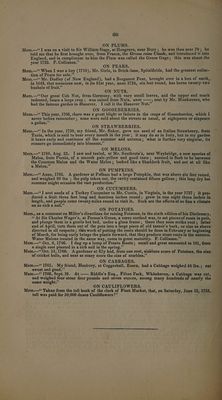
![ON PLUMS. Mem.—-* I was on a visit to Sir William Gage, at Hengrave, near Bury ; he was then near 70; he told me that he first brought over, from France, the Grosse reine Claude, and introduced it into England, and in compliment to him the Plum was called the Green Gage; this was about the year 1725. P. Collinson. ON PEARS. Mem.—-** When I was a boy (1710), Mr. Girle, in Brick-lane, Spitalfields, had the greatest collec- tion of Pears for sale.* ; Mem.—*: Mr. Dudley (of New England), had a Bergamot Pear, brought over in a box of earth, in 1643, that measures now, in its 81st year, anno 1724, six feet round, has borne tweuty-two bushels of fruit. ON NUTS. Mem.—''Our great Cob Nut, from Germany, with very small leaves, and the upper end much indented, bears a large crop; was raised from Nuts, anno , sent by Mr. Munkausen, who had the famous garden in Hanover. I call it the Hanover Nut. ON GOOSEBERRIES. Mem.—-**' This year, 1766, there was a great blight or failure in the crops of Gooseberries, which I never before remember ; none were sold about the streets as usual, at eightpence or sixpence a gallon. ON STRAWBERRIES. Mem.—-* In the year, 1759, my friend, Mr. Baker, gave me seed of an Italian Strawberry, from Turin, which is said to bear every month in the year; it may do so in Italy, but in my garden it bears early and continues all the summer and autumn; what is further very singular, its runners go immediately into blossom. ON MELONS. - Mem.—*' 1760, Aug. 23. I saw and tasted, at Mr. Southcote's, near Weybridge, a new species of. Melon, from Persia, of a smooth pale-yellow and good taste ; seemed in flesh to be between the Common Melon and the Water Melon; looked like a Shaddock fruit, and not at all like a Melon. ON PUMPKINS. Mem.—*'' Anno, 1765. A gardener at Fulham had a large Pumpkin, that was above six feet round, and weighed 80 Ibs ; the pulp taken out, the cavity contained fifteen gallons ; this long dry hot summer might occasion the vast production. ON CUCUMBERS. Mem.—-' I sent seeds of a Turkey Cucumber to Mr. Custis, in Virginia, in the year 1737 ; it pro- duced a fruit three feet long and fourteen inches round; grew in one night three inches in length, and people came twenty miles round to visit it. Such are the effects of so fine a climate on so rich a soil. ON POTATOES. Mem., as a comment on Miller's directions for raising Potatoes, in the sixth edition of his Dictionary. - ** At Sir Charles Wager's, at Parson's Green, a surer method was, to set piecesof roots in pots, and plunge them in a gentle hot bed, under a glass frame; there they soon strike root ; latter end of April, turn them out of the pots into a large piece of old tanner's bark, or else as above directed in all respects ; this work of potting the roots should be done in February or beginning of March, for being early brings the plants forward, that they produce more roots in the autamn. Water Melons treated in the same way, come to great maturity. P. Collinson. Mem.—-*: Oct, 6, 1746. I dug up a lump of Potato Roots; small and great amounted to 101, from a single root planted in a rich soil in the spring. Mem.—-'* Oct. 13, 1766. A gardener at Ely had, from one root, nirieteen score of Potatoes, the size of cricket balls, and near as many more the size of marbles. ON CABBAGES. Mem.—'* 1765. My friend, Hanbury, at Coggeshall, Essex, had a Cabbage weighed 44 ]bs.; eat sweet and good. Mem.—-' 1766, Sept. 19. At —— Riddle's Esq., Filton Park, Whitehaven, a Cabbage was cut, and weighed four stone four pounds and seven ounces, among many hundreds of nearly the same weight. ON CAULIFLOWERS. Mem.—'* Taken from the toll book of the clerk of Fleet Market, that, on Saturday, June 13, 1758, toll was paid for 30,000 dozen Cauliflowers ! :](https://iiif.wellcomecollection.org/image/b22008445_0072.jp2/full/800%2C/0/default.jpg)