Hand-book of physiology / by W. Morrant Baker and Vincent Dormer Harris.
- William Morrant Baker
- Date:
- 1892
Licence: Public Domain Mark
Credit: Hand-book of physiology / by W. Morrant Baker and Vincent Dormer Harris. Source: Wellcome Collection.
Provider: This material has been provided by the Francis A. Countway Library of Medicine, through the Medical Heritage Library. The original may be consulted at the Francis A. Countway Library of Medicine, Harvard Medical School.
133/914 (page 111)
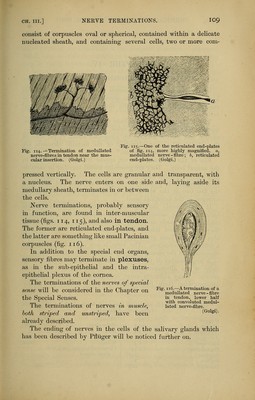
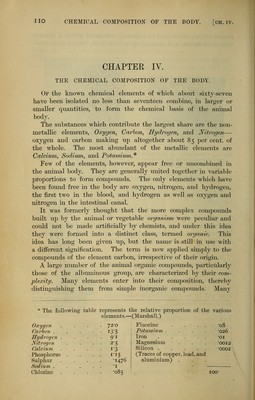
![CH. iv.] ORGANIC SUBSTANCES. 11 I atoms of the same element occur in each molecule. This latter fact no doubt explains the reason of their instability. Another great cause of the instability is the frequent presence of nitrogen, which may be called negative or undecided in its affinities and may be easily separated from combination with other elements. Animal tissues, containing as they do these organic nitrogenous compounds, are extremely prone to undergo decomposition. They also contain much water, a circumstance very favourable to the breaking up of such substances. It is due to this tendency to decomposition that we meet with so large a number of decom- position products among the chemical substances forming the basis of the animal body. The various substances found in the animal organism may be conveniently considered according to the following classifica- tion :—i. Organic—a. Nitrogenous and b. Non-Nitrogenous. 2. Inorganic. Organic Substances. Nitrogenous organic bodies take the chief part in forming the solid tissues of the body, and are found also to a considerable extent in the circulating fluids (blood, lymph, chyle), the secre- tions and excretions. They often contain in addition to carbon, hydrogen, nitrogen, and oxygen, the elements sulphur and phosphorus ; but although the composition of most of them is approximately known, no general rational formula can at present be given. It will be convenient to give an account of the Proteids and Gelatins in this Chapter, as these constitute the most important classes of nitrogenous organic substances. The other members are Decomposition products, the chief of which is Urea, found for the most part in the urine ; Ferments; Pigments; and other bodies and will be more appropriately treated of later on. Proteids are also called Albuminous substances. They are the chief of the nitrogenous organic compounds and exist in both plants and animals, one or more of them entering as an essential part into the formation of all living tissue. In the lymph, chyle, and blood, they exist abundantly. Very little is known with any certainty about their chemical composition. Not a single member of the class has yet been synthesized. Their formula is unknown, the chemists who have attempted to construct it differing very greatly among themselves. In fact the very term proteid is an extremely arbitrary one. It simply means a body which, according to Hoppe-Seyler, contains in its molecule the elements carbon.](https://iiif.wellcomecollection.org/image/b21039550_0133.jp2/full/800%2C/0/default.jpg)