A first step in the analysis of the dog's ventricular electrocardiogram : preliminary communication / by Thomas Lewis.
- Thomas Lewis
- Date:
- [1915]
Licence: Public Domain Mark
Credit: A first step in the analysis of the dog's ventricular electrocardiogram : preliminary communication / by Thomas Lewis. Source: Wellcome Collection.
2/4
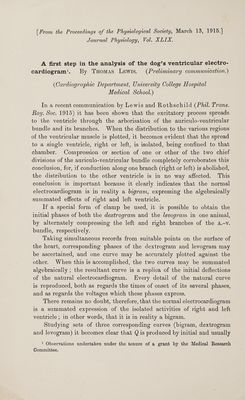
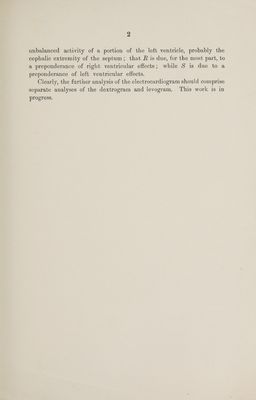
![[From the Proceedings of the Physiological Society, March 13, 1915. ] Journal Physiology, Vol. XLIX. A first step in the analysis of the dog’s ventricular electro- cardiogram!. By Tuomas Lewis. (Preliminary communication.) (Cardiographic Department, Uniwersity College Hospital Medical School.) In a recent communication by Lewis and Rothschild (Phil. Trans. Roy. Soc. 1915) it has been shown that the excitatory process spreads to the ventricle through the arborisation of the auriculo-ventricular bundle and its branches. When the distribution to the various regions of the ventricular muscle is plotted, it becomes evident that the spread to a single ventricle, right or left, is isolated, being confined to that chamber. Compression or section of one or other of the two chief divisions of the auriculo-ventricular bundle completely corroborates this conclusion, for, if conduction along one branch (right or left) is abolished, the distribution to the other ventricle is in no way affected. This conclusion is important because it clearly indicates that the normal electrocardiogram is in reality a bigram, expressing the algebraically summated effects of right and left ventricle. If a special form of clamp be used, it is possible to obtain the initial phases of both the dextrogram and the levogram in one animal, by alternately compressing the left and right branches of the A.—v. bundle, respectively. Taking simultaneous records from suitable points on the surface of the heart, corresponding phases of the dextrogram and levogram may be ascertained, and one curve may be accurately plotted against the other. When this is accomplished, the two curves may be summated algebraically ; the resultant curve is a replica of the initial deflections of the natural electrocardiogram. Every detail of the natural curve is reproduced, both as regards the times of onset of its several phases, and as regards the voltages which these phases express. There remains no doubt, therefore, that the normal electrocardiogram is a summated expression of the isolated activities of right and left ventricle ; in other words, that it is in reality a bigram. Studying sets of three corresponding curves (bigram, dextrogram and levogram) it becomes clear that Q is produced by initial and usually 1 Observations undertaken under the tenure of a grant by the Medical Research Committee.](https://iiif.wellcomecollection.org/image/b33430597_0002.jp2/full/800%2C/0/default.jpg)