Volume 1
A dictionary of medicine : including general pathology, general therapeutics, hygiene, and the diseases of women and children / by various writers ; edited by Richard Quain ; assisted by Frederick Thomas Roberts and J. Mitchell Bruce ; with an American appendix by Samuel Treat Armstrong.
- Richard Quain
- Date:
- 1895, ©1894
Licence: Public Domain Mark
Credit: A dictionary of medicine : including general pathology, general therapeutics, hygiene, and the diseases of women and children / by various writers ; edited by Richard Quain ; assisted by Frederick Thomas Roberts and J. Mitchell Bruce ; with an American appendix by Samuel Treat Armstrong. Source: Wellcome Collection.
Provider: This material has been provided by The University of Leeds Library. The original may be consulted at The University of Leeds Library.
76/1258 (page 48)
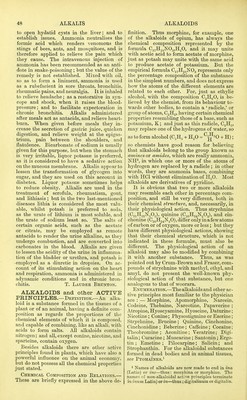
![to open hydatid cysts in the liver; and to establish issues. Ammonia neutralises the formic acid which renders venomous the stings of bees, ants, and mosquitoes, and is therefore applied to relieve the pain which they cause. The intravenous injection of ammonia has been recommended as an anti- dote in snake-poisoning ; but the value of the remedy is not established. Mixed with oil, so as to form a liniment, ammonia is used as a rubefacient in sore throats, bronchitis, rheumatic pains, and neuralgia. It is inhaled to relieve headache; as a restorative in syn- cope and shock, when it raises the blood- pressure ; and to facilitate expectoration in chronic bronchitis. Alkalis administered after meals act as antacids, and relieve heart- burn. When given before meals they in- crease the secretion of gastric juice, quicken digestion, and relieve weight at the epigas- trium, pain between the shoulders, and flatulence. Bicarbonate of sodium is usually given for this purpose, but when the stomach is very irritable, liquor potassae is preferred, as it is considered to have a sedative action on the mucous membrane. Alkalis appear to lessen the transformation of glycogen into sugar, and they are used on this account in diabetes. Liquor potassse sometimes helps to reduce obesity. Alkalis are used in the treatment of scrofula, rheumatism, gout, and lithiasis ; but in the two last-mentioned diseases lithia is considered the most valu- able, whilst potash is preferred to soda, as the urate of hthium is most soluble, and the urate of sodium least so. The salts of certain organic acids, such as the acetate or citrate, may be employed as remote antacids to render the urine alkaline, as they undergo combustion, and are converted into carbonates in the blood. Alkalis are given to lessen the acidity of the urine in inflamma- tion of the bladder or urethra, and potash is • employed as a diuretic in dropsies. On ac- count of its stimulating action on the heart and respiration, ammonia is administered in adynamic conditions and in chronic bron- chitis. T. Lauder Brunton. ALKALOIDS and other ACTIVE PRINCIPLES.— Definition.—An alka- loid is a substance formed in the tissues of a plant or of an animal, having a definite com- position as regards the proportions of the chemical elements of which it is composed, and capable of combining, like an alkali, with acids to form salts. All alkaloids contain nitrogen; and all, except conine, nicotine, and sparteine, contain oxygen. Besides alkaloids there are other active principles found in plants, which have also a powerful influence on the animal economy, but do not possess all the chemical properties just stated. Chemical Composition and Belations.— These are briefly expressed in the above de- finition. Thus morphine, for example, one of the alkaloids of opium, has always the chemical composition represented by the formula C17H19N03,H.,0, and it may unite with acetic acid to form acetate of morphine, just as potash may unite with the same acid to produce acetate of potassium. But the empirical formula C]7HlgN03 represents only the percentage composition of the substance in the simplest numbers, and does not express how the atoms of the different elements are related to each other. For, just as ethylic alcohol, with the composition C.2H60, is be- lieved by the chemist, from its behaviour to- wards other bodies, to contain a ' radicle,' or group of atoms, C2H5, having certain chemical properties resembling those of a base, such as potassium, K; and just as this radicle, C2H5, may replace one of the hydrogens of water, so as to form alcohol (C2H5 + H20 = C^50 + H); so chemists have good reason for believing that alkaloids belong to the group known as amines or amides, which are really ammonia, NH3, in which one or more of the atoms of hydrogen are replaced by a radicle ; in other words, they are ammonia bases, combining with HC1 without elimination of H20. Most alkaloids are derivatives of pyridine. It is obvious that two or more alkaloids may resemble each other in percentage com- position, and still be very different, both in their chemical structure, and, necessarily, in their physiological action. Thus strychnine (C21H22N202), quinine (C20H24N2O2), and cin- chonine (C20H24N2O), differ only in a few atoms of carbon or of oxygen, more or less ; but they have different physiological actions, showing that their chemical structure, which is not indicated in these formulae, must also be different. The physiological action of an alkaloid may also be modified by combining it with another substance. Thus, as was pointed out by Crum-Brown and Fraser, com- pounds of strychnine with methyl, ethyl, and amyl, do not present the well-known phy- siological action of that substance, but one analogous to that of woorara. Enumeration.—The alkaloids and other ac- tive principles most familiar to the physician are : — Morphine, Apomorphine, Narcein, Codeine, Thebaine, Narcotine, Papaverine ; Atropine, Hyoscyamine, Hyoscine, Daturine; Nicotine; Conine; PhysostigmineorEserine; Strychnine, Brucine; Quinine, Cinchonine, Cinchonidine ; Beberine ; Caffeine ; Cocaine; Theobromine; Aconitine; Veratrine; Digi- talin; Curarine ; Muscarine ; Santonin; Ergo- tin ; Emetine ; Pilocarpine; Salicin; and Strophanthin. For the alkaloidal substances formed in dead bodies and in animal tissues, see Ptomaines.1 1 Names of alkaloids are now made to end in ina (Latin) or inc—thus: morphina or morphine. The names of nora-alkaloidal active principles terminate in inum Latin) or in—thus: digitalinum or digital in.](https://iiif.wellcomecollection.org/image/b21503229_0001_0076.jp2/full/800%2C/0/default.jpg)