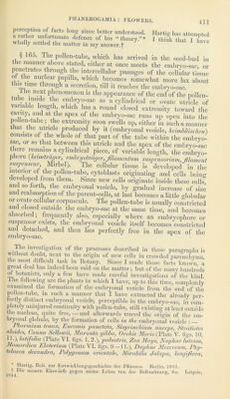
Principles of scientific botany, or, Botany as an inductive science / by J.M. Schleiden ; translated by Edwin Lankester.
- Date:
- 1849
Licence: Public Domain Mark
Credit: Principles of scientific botany, or, Botany as an inductive science / by J.M. Schleiden ; translated by Edwin Lankester. Source: Wellcome Collection.
Provider: This material has been provided by the Royal College of Physicians of Edinburgh. The original may be consulted at the Royal College of Physicians of Edinburgh.
426/646
![Limnanthes Douglasii, Linurn pallescens, Tropceolum majus, Cicer arie- tinum, Phaseolus vulgaris, CEnothera viminea, crassipes, rhizocarpa (Plate VI. figs. 7, 8.), Martynia diandra (Plate VL figs. 5, 6.), Salvia bicolor (Plate VI. figs. 3, 4.), Latlircea Squamaria, Veronica hedercefolia, serpyllifolia, Pedicularis palustris, Cynanchum nigrum, Campanula Medium, Tetragonia exp ansa, Epilobium hirsutum (Plate V. figs. 7, 8.). In many of these plants I have laboured in vain for many years; in some I have oftener succeeded in observing the whole process without the possibility of deception : I have never yet found any plants in which the observation is so easy, that I could say that I could at any time prepare the necessary dissection with certainty ; I have found it easiest in CEnothera, Veronica, Pedicularis, and the Orchidacece. If Santalum album were at our command, we should probably have a plant in which we could at any time demonstrate the process with certainty. Perfect confirmation of the main point, namely, the conversion of the end of the pollen-tube into the embryo through internal processes of vegetation, have been furnished by Wydler * * * § in some species of Scrophularia, by Meyen f in Fritillaria imperialis and Tulipa, and by Gelesnoff J in Amygdalus persica, lberis amara and umbellata. The observation of Meyen is the better evidence that it came certainly quite unsought for ; since it is alone quite sufficient to refute his very artificial, and, I will openly confess, to me thoroughly incomprehensible, explanation of his other less perfect observations. The figures 37—43. Plate XIII., from Alsine media, of Meyen, also agree tolerably perfectly with my observa- tions, only I do not rightly know what to make of figures 38 to 41. I must confess that it has hitherto always appeared to me impossible to prepare it free in so early a condition in Alsine media, and these obser- vations do not at all agree with Meyen’s explanation; moreover, figs. 21—23. from Dr aba verna, fig. 34. from Orchis Morio, fig. 44. from Helianthemum canariense, fig. 48, 49. from the same plant, only the order is evidently different; fig. 49 is an earlier condition, fig. 48 the commencement of the constriction of the pollen-tube; lastly, also, (Polyembryonie, &c., Plate I.), from Viscum album, on which I will merely notice that fig. 8. is evidently later impregnated, and an earlier stage of formation than fig. 7., which follows from the fact that the membrane of the embryo-sac is not yet completely absorbed, and there- fore still surrounds the contained cells with a smooth outline. All the rest of Meyen’s figures exhibit only later conditions, after the separation of the pollen-tube outside the embryo-sac, often even after the separation of the germinal vesicle inside it. Lastly, Griffith § has instituted researches on this process in Santalum album, and indeed earlier, before my obser- vations were made known ; unfortunately, he evidently had not a good microscope at his command, and lie is candid enough not to describe, or draw as definitely seen, anything which remained indistinct to him. Santalum album is certainly a most advantageous plant for these researches. Ihe allied species of Thesium present great difficulty. On the other hand, Marti us |], in the year 1844, published the following passage of a letter from Griffith: “ A year ago I sent an extended essay * Loc. cit. t ^ hysiologie, vol. iii.; and Ueber den Befruchtungsact und die Polyembrionie, &c. Berlin, 1840. ° } J Botan. Zeitung, vol. i. p. 841. § On the Ovulum of Santalum album, Trans. Roy. Soc. vol. xviii. II Munich gel. Anzeig. No. cxliii. p. 107.](https://iiif.wellcomecollection.org/image/b28043534_0426.jp2/full/800%2C/0/default.jpg)