A concise dictionary, English-Persian : together with a simplified grammar of the Persian language / by the late E.H. Palmer, completed and edited from the ms. left imperfect at his death by G. Le Strange.
- Edward Henry Palmer
- Date:
- 1930
Licence: Public Domain Mark
Credit: A concise dictionary, English-Persian : together with a simplified grammar of the Persian language / by the late E.H. Palmer, completed and edited from the ms. left imperfect at his death by G. Le Strange. Source: Wellcome Collection.
23/344 page 5
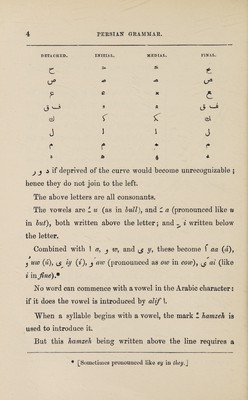
![prop: this in the case of a is I, in the case of u it is j* and in the case of i it is (j* only that in the initial form this last is [often] distinguished from the ordinary y by losing its dots : e.g. su-dl, “a question;” JJ*** mas-ul, “inquired ofsjdU fd-idah, “ advantage.” * TasMid doubles the letter it is placed over. ° Sukun shows that the letter it is placed over has no vowel. * Waslah is only used over an initial alif in an Arabic word, or over the Arabic article J1 al, and shows that it is elided. Maddah is placed over an initial alif,\ and shows that it should be pronounced long, as dmadan, “ to come.” If the first letter of an Arabic word be a sibilant or liquid the article J1 is elided before it, and the consonant itself SlrO J Cts vifO jCj , doubled, as ^Ul ^\j& 'avammu-nnas, “common people,” 4l1 a-c 'abdu-lldJi, “Abdullah” (the servant of Allah). [In Persian words j after &. followed by a long vowel is not pronounced, e.g. kMsh, khastan.] In old Persian, and in the language as spoken in India at the present day, the long j and have two sounds, u and % called ma'ruf “known,” and o and d, called majhul, “ unknown.” The modern native of Iran does not [often] employ the latter sounds. * [With or without £.]](https://iiif.wellcomecollection.org/image/b3135001x_0023.jp2/full/800%2C/0/default.jpg)