A concise dictionary, English-Persian : together with a simplified grammar of the Persian language / by the late E.H. Palmer, completed and edited from the ms. left imperfect at his death by G. Le Strange.
- Edward Henry Palmer
- Date:
- 1930
Licence: Public Domain Mark
Credit: A concise dictionary, English-Persian : together with a simplified grammar of the Persian language / by the late E.H. Palmer, completed and edited from the ms. left imperfect at his death by G. Le Strange. Source: Wellcome Collection.
26/344 (page 8)
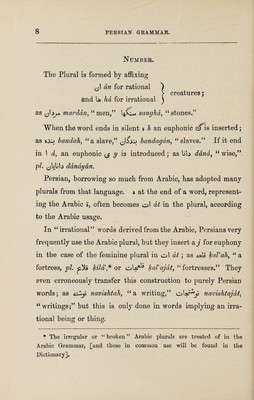
![Number. The Plural is formed by affixing J\ an for rational > creatures; and U ha for irrational \ as mar dan, “ men,” sangha, “ stones.” When the word ends in silent 5 h an euphonic (^ls inserted; as handah, “a slave,” handagan, “ slaves.” If it end in I a, an euphonic y is introduced; as lib “wise,” £>?. ^hlib dandy an. Persian, borrowing so much from Arabic, has adopted many plurals from that language. $ at the end of a word, represent¬ ing the Arabic i, often becomes ol at in the plural, according to the Arabic usage. In “irrational” words derived from the Arabic, Persians very frequently use the Arabic plural, but they insert a j for euphony in the case of the feminine plural in cd at; as i.x\s kaVah, “ a fortress, pi. kila ,* or kaVajdt, “ fortresses.” They even erroneously transfer this construction to purely Persian words; as navishtah, “a writing,” oUF^jj navishtajat, “writings;” but this is only done in words implying an irra¬ tional being or thing. * The irregular or “ broken ” Arabic plurals are treated of in the Arabic Grammar, [and those in common use will be found in the Dictionary],](https://iiif.wellcomecollection.org/image/b3135001x_0026.jp2/full/800%2C/0/default.jpg)