A concise dictionary, English-Persian : together with a simplified grammar of the Persian language / by the late E.H. Palmer, completed and edited from the ms. left imperfect at his death by G. Le Strange.
- Edward Henry Palmer
- Date:
- 1930
Licence: Public Domain Mark
Credit: A concise dictionary, English-Persian : together with a simplified grammar of the Persian language / by the late E.H. Palmer, completed and edited from the ms. left imperfect at his death by G. Le Strange. Source: Wellcome Collection.
28/344 (page 10)
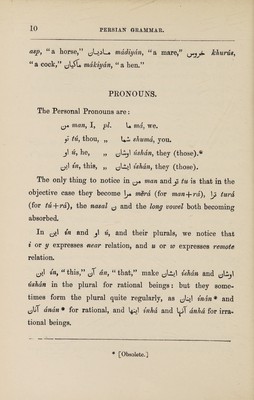
![asp, “a horse,” (jLpL* madiydn, “a mare,” Jchurus, u a cock,” mdkiydn, “a hen.” PEONOUNS. The Personal Pronouns are: I, pi. U we. y> tu, thou, „ 1*^ shumd, you. jl u, he, „ (jlijl ushdn, they (those).# in, this, „ (jUj) ishan, they (those). The only thing to notice in ^ and Ji tu is that in the objective case they become ]/• merd (for man+ra), \j> turd (for tu-\-rd), the nasal ^ and the long vowel both becoming absorbed. In in and jl u, and their plurals, we notice that i or y expresses near relation, and u or w expresses remote relation. (n9 “ this,” Jf an, “ that,” make J&] ishan and ushdn in the plural for rational beings: but they some¬ times form the plural quite regularly, as man * and ijlil andn * for rational, and inhd and anhd for irra* tional beings.](https://iiif.wellcomecollection.org/image/b3135001x_0028.jp2/full/800%2C/0/default.jpg)