A concise dictionary, English-Persian : together with a simplified grammar of the Persian language / by the late E.H. Palmer, completed and edited from the ms. left imperfect at his death by G. Le Strange.
- Edward Henry Palmer
- Date:
- 1930
Licence: Public Domain Mark
Credit: A concise dictionary, English-Persian : together with a simplified grammar of the Persian language / by the late E.H. Palmer, completed and edited from the ms. left imperfect at his death by G. Le Strange. Source: Wellcome Collection.
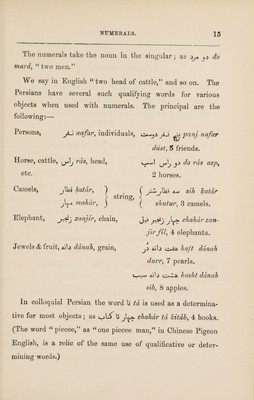
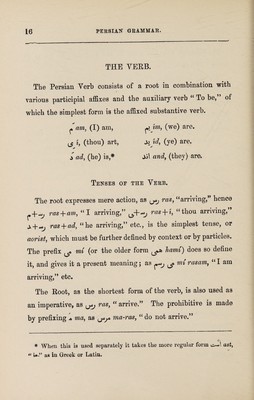
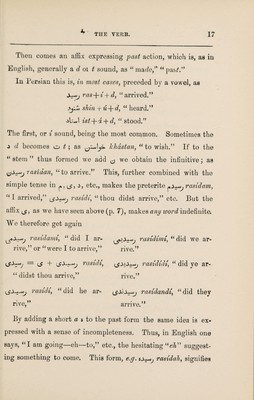
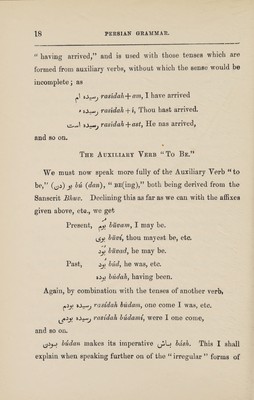
31/344 page 13
![^ man Jcih fulan pisar ifulanam, I, so-and-so, the son of so-and-so. ^ man Jcihpisaram raft, I whose son went. & j) tu Jcih pisarat raft, Thou whose son went. &f u Jcih pimrash raft, He whose son went. With ^ &£ may be compared the qui of European languages. It serves for all relatives, but may be defined by other words, as in the above examples. Comparison. The comparative is formed by adding J tar, and the superla¬ tive by adding tarin. A single example will impress this on the reader’s mind : 4, bih, good, 3 bih-tar, better, bih-tarin, best. Sometimes the Arabic comparative form Jjtsl af’al is used in Persian. [But of this form examples are cited in the Dictionary.] NUMERALS. The numerical figures! are r2 ^ °5 ] v, *8 J J They are written from left to right as with us, and are combined in the same way as our own; e.g. iaai=1881.](https://iiif.wellcomecollection.org/image/b3135001x_0031.jp2/full/800%2C/0/default.jpg)