Licence: Public Domain Mark
Credit: Pneumonia and typhoid fever : a study. Source: Wellcome Collection.
Provider: This material has been provided by the Augustus C. Long Health Sciences Library at Columbia University and Columbia University Libraries/Information Services, through the Medical Heritage Library. The original may be consulted at the the Augustus C. Long Health Sciences Library at Columbia University and Columbia University.
15/46 page 9
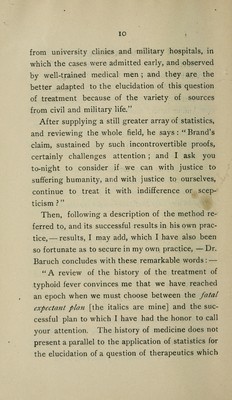
![have not and cannot be controverted, by which it is clearly demonstrated that this treatment, as originally recommended by him [that is, not in the 'half-hearted' form] in 1861, has reduced the mortality in typhoid fever to less than 4 per cent. The latter, however, still contains many imperfectly managed cases. Eliminating these, the number treated by Juergensen, Vogl, and J3rand, up to 1887, amounted to 1,223 cases, of which twelve only died, or l per cent. And yet this is not all, for the most significant fact deducible from these statistics remains to be told. Not a single one of these twelve deaths oc- curred in any case that came under treat^nent before the fifth day. It would seem a bold assertion to claim that all cases of typhoid fever may, by early treatment, be rendered so mild as to tend almost invariably to recovery. But the assertion is boldy made by Brand, on the strength of these 1,223 cases, of which he treated one fourth himself, the remainder coming from Juergensen's hospital at Tubingen, Vogl's at Munich, and the military hos- pitals at Stralsund and Stettin.* *' The exactness of these figures, continues Dr. Baruch, cannot be doubted, coming as they do ♦Deutsch Med. Wochensehrift, 3 Mch. 1887, p. 179.](https://iiif.wellcomecollection.org/image/b21211346_0015.jp2/full/800%2C/0/default.jpg)