Micro-organisms of the human mouth : the local and general diseases which are caused by them / by Willoughby D. Miller.
- Date:
- 1890
Licence: Public Domain Mark
Credit: Micro-organisms of the human mouth : the local and general diseases which are caused by them / by Willoughby D. Miller. Source: Wellcome Collection.
Provider: This material has been provided by the University of Toronto, Harry A Abbott Dentistry Library, through the Medical Heritage Library. The original may be consulted at the Harry A Abbott Dentistry Library, University of Toronto.
143/400 page 117
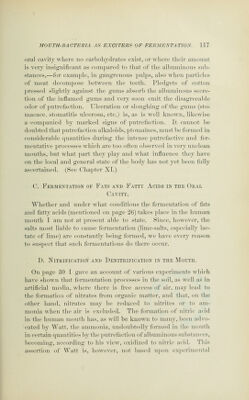
![oral cavity where no carliohydrates exist, or where their amount is very insignificant as compared to that of the alluiminous sub- stances,—for example, in gangrenous pulps, also when particles of meat decompose between the teeth. Pledgets of cotton pressed slightly against the gums absorb the albuminous secre- tion of the inflamed gums and very soon emit the disagreeable odor of putrefaction. Ulceration or sloughing of the gums (sto- macace. stomatitis ulcerosa, etc.) is, as is well known, likewise a companied by marked signs of putrefaction. It cannot be doubted that putrefaction alkaloids, ptomaines, must be formed in considerable quantities during the intense putrefactive and fer- mentative processes which are too often observed in very unclean mouths, but what part they play and what influence they have on the local and general state of the l)0(ly has not yet been fully ascertained. (See Chapter XL) C\ Fermentation of Fats and Fatty Acids in the Oral Cavity. AVhether and under what conditions the fermentation of fats and fatty acids (mentioned on page 26) takes place in the human mouth I am not at present able to state. Since, however, the salts most lial)le to t-ause fermentation (lime-salts, especially lac- tate of lime) are constantly being formed, we have every reason to suspect that such fermentations do there occur. I). Xitkification and Denitrification in the Mouth. On page 30 I gave an account of various experiments which have shown that fermentation processes in the soil, as well as in artificial media, where there is free access of air, may lead to the formation of nitrates fi'om organic matter, and that, on the other hand, nitrates may be reduced to nitrites or to am- monia when the air is excluded. The formation of nitric acid in the human mouth has, as will be known to many, l)een advo- cated by AVatt, the ammonia, undoubtedly formed in the mouth in certain quantities by the ]»utrefaction of albuminous substances, becoming, according to his view, oxidized to nitric acid. This assertion of AVatt is, however, not based upon experimental](https://iiif.wellcomecollection.org/image/b2120293x_0143.jp2/full/800%2C/0/default.jpg)