Volume 1
The mind of the child : observations concerning the mental development of the human being in the first years of life / by W. Preyer ; translated, from the original German, by H.W. Brown.
- Date:
- 1890
Licence: Public Domain Mark
Credit: The mind of the child : observations concerning the mental development of the human being in the first years of life / by W. Preyer ; translated, from the original German, by H.W. Brown. Source: Wellcome Collection.
Provider: This material has been provided by the Royal College of Physicians of Edinburgh. The original may be consulted at the Royal College of Physicians of Edinburgh.
361/396 (page 327)
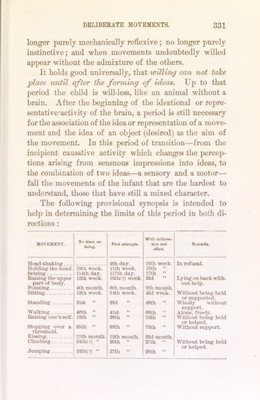
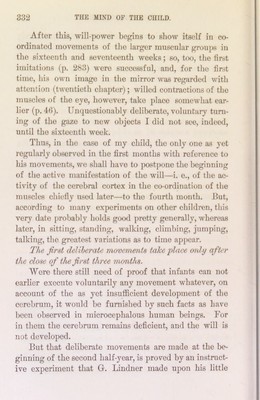
![against another object held in his hand, and to exchange both objects suddenly, moving the spoon with the other hand, which gave exactly the impression of testing whether the noise proceeded from the one arm only, or would arise likewise in case this arm were motionless (p. 87). The restless experimenting of little children, especially in the first attempts at accommodation (p. 54) [of the eye]—even quite insignificant practices (like the crumpling of paper from the third to the sixth month), are not only useful but indispensable for the intellectual development. Moreover, it is essential to consider, in regard to the cultivation of the will, because thereby the understanding is gradually awakened, how ineffi- cient most of the early, unrepresented, non-cobrdmated movements were, and how useful, on the contrary, are the co-ordinated movements with definite aims. Only when both occur together, the representation of the movement and the expectation of its result, is deliberate movement possible, which, unfortunately, is too often prevented through training from showing itself earlv. Often even in the second year we can tell only with difficulty, or can not tell at all, whether the child acts independently or not—e. g., when (in the sixteenth month) he opens and shuts cupboards, picks up from the floor and brings objects that he threw down. When, on the contrary, at this period, he holds, entirely of his own motion, an ear-ring that had been taken off, to the ear from which it was taken, I am inclined to see in that already a sign of deliberation—understanding and choice—whereas in the mere making of noise—it may be by opening and slamming-to the cover of a box, or by the eager tearing of newspapers—there is rather the](https://iiif.wellcomecollection.org/image/b21938994_0001_0361.jp2/full/800%2C/0/default.jpg)