John Locke, 1632-1704, physician and philosopher : a medical biography / with an edition of the medical notes in his journals.
- Kenneth Dewhurst
- Date:
- 1963
Licence: Attribution-NonCommercial 4.0 International (CC BY-NC 4.0)
Credit: John Locke, 1632-1704, physician and philosopher : a medical biography / with an edition of the medical notes in his journals. Source: Wellcome Collection.
153/374 page 123
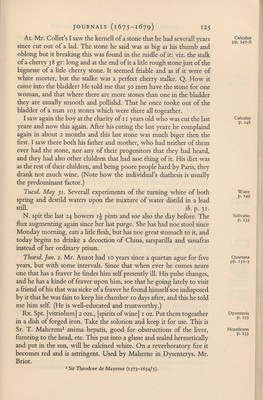
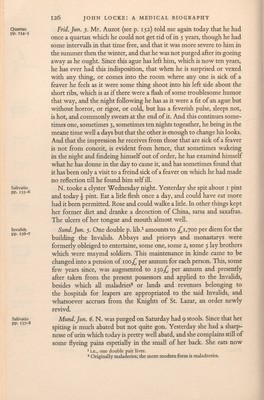
![left hand. He told me [he] had one formerly on his thumb much biger and longer then this on the midle finger before mentioned, but it was now very short, haveing been either takn off or dropd of, I knew not whether; for on all the rest of his fingers on both his hands were the like, only on some of them, they had been taken off by the chirurgons since he came into the Hospital, but in those that had not been touchd there was a great inequality in their length, some of them beginning to sprout much since the other. The same also was upon the toes of his feet, only excepting the two least toes of each foot where there were now none, and upon 3 of them there never had been; upon the 4, i.e. the litle toe of the right foot, as I remember, there had been one but it haveing fallen off about 6 months since it came noe more but left the naile very little different from naturall. This horny substance grew not out of the end of the fingers but was as it were a thickening of the naile, which instead of growing out in length increasd in thicknesse, but rose not up straight in a perpendicular line to the finger but as it augmentd bended forwards and soe grew some what into the shape of a birds claw but that it was not taper and sharp like that, but blunt at the end and almost of the same bigness all along, and full of pretty deep chaps 1 in the convex part but the concave without any. He had noe sense in the horny part it self, for I saw the peices before mention'd brok'n of by wresting several ways, but he complaind of paine when bending the upper part. The part that joyned on to his finger was not held very firme and steady, and those of his feet were soe tender that he complaind upon very gently touching of them, but the sensibility is not in the horny excrescence but in the part where it joyns on to the flesh i.e. where the naile formerly did grow. There is also in severall parts of the back of his hands horny excres- ences, some pretty broade, and others lesse, but none riseing much above the skin, but they looke there those that are broad like flat but very broad warts, but to the touch they feele much harder. This disease began upon this lad about 3 years since after haveing had the small pox which is the only thing to which he imputes it. v. p. 146. I saw at the same time in the same hospital a stone that was yesterday cut out of a lad of eleven years old. It was of an irregular figure nearest an ovali, whose circumference the long way was 450 gr: and girt crosse above 360 gr: The matter of the stone was very fryable and consistd of severall cotes one over another like an onyen as most of the stones generatd in the bodys of animals are. I thought it not strange to finde soe large a 1 O.E.D., Cracks or fissures.](https://iiif.wellcomecollection.org/image/b20086283_0153.JP2/full/800%2C/0/default.jpg)
 No text description is available for this image
 No text description is available for this image
 No text description is available for this image