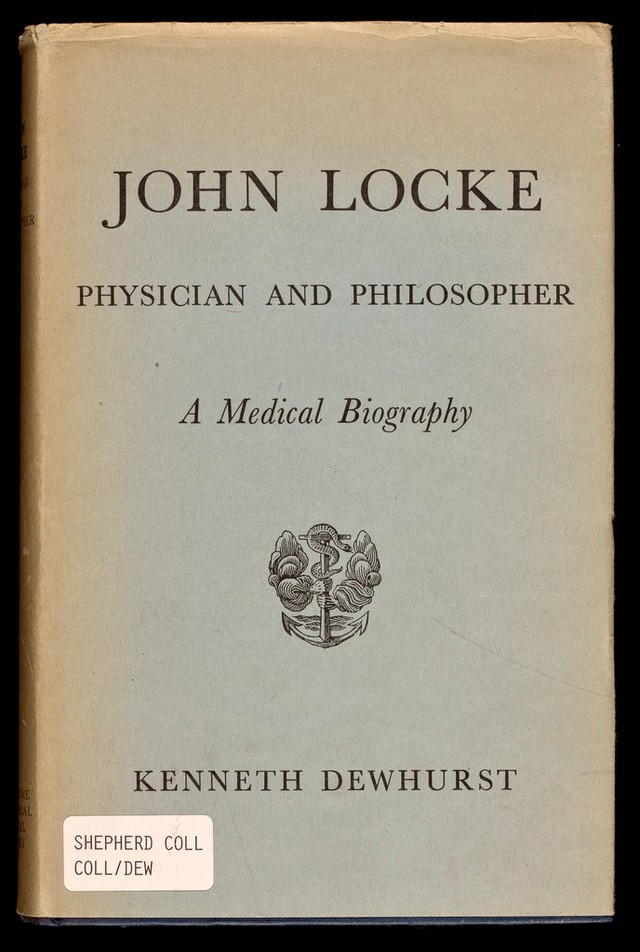
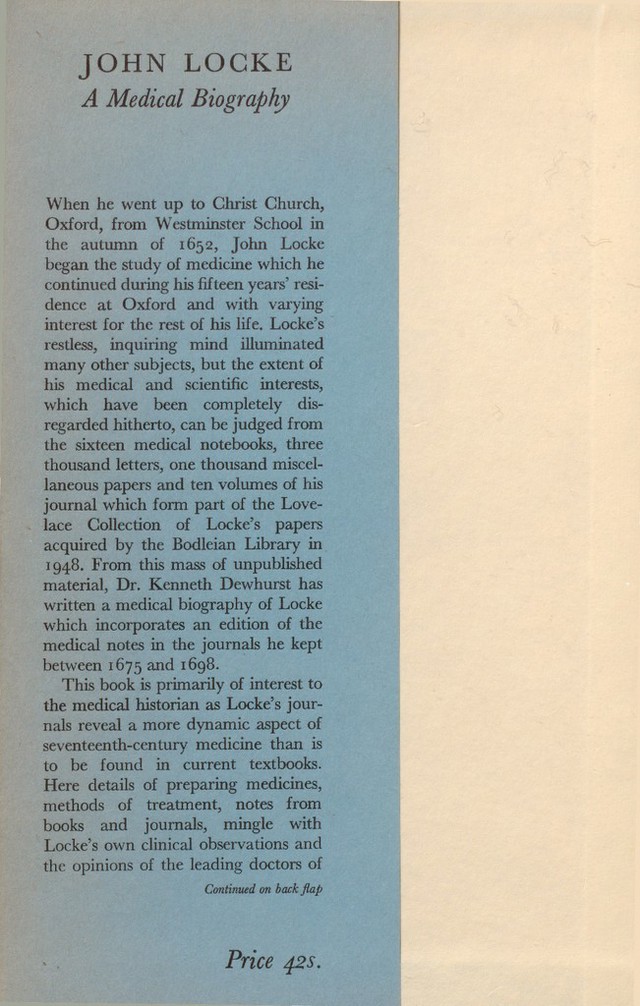
John Locke, 1632-1704, physician and philosopher : a medical biography / with an edition of the medical notes in his journals.
- Kenneth Dewhurst
- Date:
- 1963
Licence: Attribution-NonCommercial 4.0 International (CC BY-NC 4.0)
Credit: John Locke, 1632-1704, physician and philosopher : a medical biography / with an edition of the medical notes in his journals. Source: Wellcome Collection.
164/374 page 134
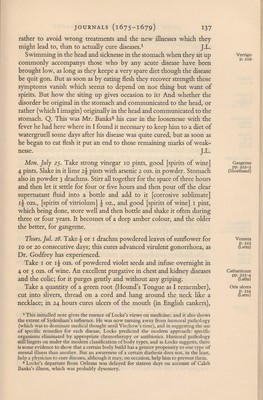
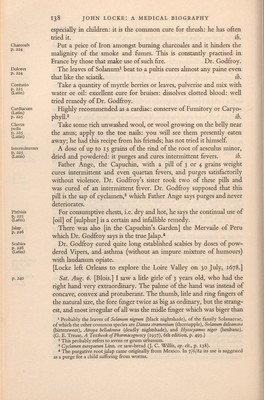
![Deauratio p. 209 (Latin) Magnétisme (Latin) Vertigo p. 210 Haemorrhoids p. 210 Hysterica p. 211 (Latin) Septalius p. 211 (Latin) Pestis pp. 211-13 (Latin) Tuesd. Jul. ig. Dissolve [gold] in [aqua regis], evaporate it, mix the remaining powder with an equal quantity of [nitre] and evaporate; you will have a red powder, which moistened with saliva will gild silver simply by rubbing. This powder is dissolved into a red liquor by the aforementioned Alkahest of Glauber. ib. Certain bodies by long habit seem to acquire a kind of magnetism; not only iron objects kept for long in a certain position, but even wooden ones, so that pieces of wood which have had the same relative positions (e.g., beds or chairs) if they are pulled apart and thrown into still water, they return in the water to the same relative positions which they had previously out of the water, e.g., parallels will be parallel, transverse will be transverse. Dr. Godfroy tells me that haveing hung a bag of litle peices of elder, growing upon sallow, upon the pit of the stomach of one who was troubld with a vertigo, he has been well of it ever since. But whether it be to be imputed to the elder or the vomit he gave him he determins not. This he tried upon the Credit of Hartman, 1 though he minded not his criticali gathering of it. He gatherd his about September. He vouches also Hartman's Linament for painful haemorrhoids. Wed. Jul. 20. In hysterical attacks Dr. Godfroy found great value in up to 5 gr. of camphor mixed in clysters. L. Septalii 2 animadversionum et cautionum medicarum libri 9, 8° Patavii 1652, 608 pp. The use of vesicatories [blistering plasters] is treated in my book on The Plague, written in my youth during my country's calamity when I was immersed in treating that disease. ib. Bk 5, para 45. I can assert from experience that in cases of plague the body should be purged from the start, for I and my colleagues had enormous success during the great pestilence in this great city, since we used purging medicines almost from the beginning of the treatment. Gentilis Fulginas also declares that experimentally he hit on the same method in Bk. 4, where he says: I saw our colleagues, men of experience, 1 Probably George Hartmann who was Sir Kenelm Digby's laboratory assistant. After Digby's death Hartmann published a Book of Chymicall Secrets (1682). (Wootton, op. cit., vol. I, p. 196.) His aqua viridis is mentioned in 6/2/80 and his arcanum vitrioli (perhaps sulphate of iron) in 17/6/80 and 17/6/82. 2 Ludovico Settala (Septalius) (1552-1633) studied medicine at Pavia and became a professor at the age of twenty-three. Practised most of his life at Milan where he was appointed Chief Medical Officer to the State in 1627. He studied the Plague during the big epidemic of 1628. His books on the Plague are De Peste et Pestiferis Adfectibus (1622) and Della Preservazione della Peste (1630). His Animadversionum, et Cautionum Medicorum libri vii, published in 1614, was based on his experiences during forty years of medical practice. Septalius also wrote In Librum Hippocrates Coi de Aeribiis, etc. (1590) and De Naevis Liber (1606). (Biographie Médicale (1855), Paris, vol. I, p. 316.)](https://iiif.wellcomecollection.org/image/b20086283_0164.JP2/full/800%2C/0/default.jpg)
 No text description is available for this image
 No text description is available for this image
 No text description is available for this image