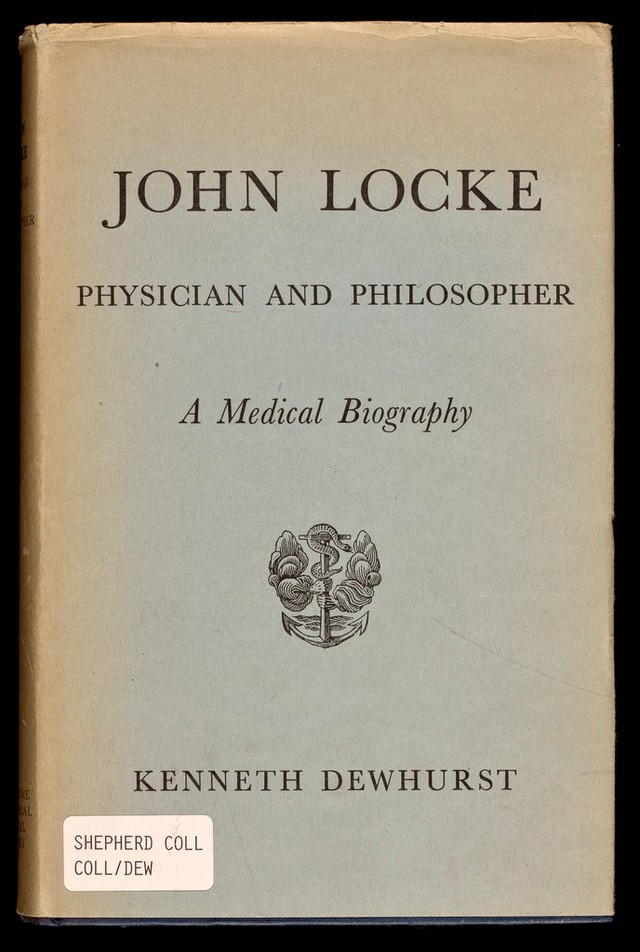
John Locke, 1632-1704, physician and philosopher : a medical biography / with an edition of the medical notes in his journals.
- Kenneth Dewhurst
- Date:
- 1963
Licence: Attribution-NonCommercial 4.0 International (CC BY-NC 4.0)
Credit: John Locke, 1632-1704, physician and philosopher : a medical biography / with an edition of the medical notes in his journals. Source: Wellcome Collection.
173/374 page 143
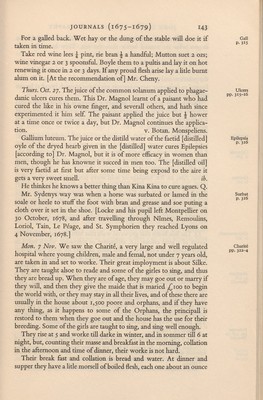
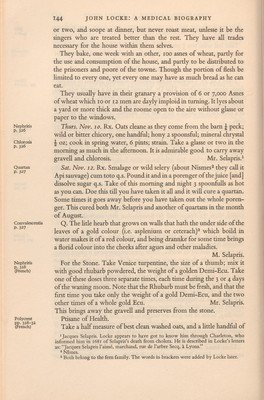
![For a galled back. Wet hay or the dung of the stable will doe it if taken in time. Take red wine lees J pint, rie bran \ a handful; Mutton suet 2 ozs; wine vinegar 2 or 3 spoonsful. Boyle them to a pultis and lay it on hot renewing it once in 2 or 3 days. If any proud flesh arise lay a litle burnt alum on it. [At the recommendation of] Mr. Cheny. Thürs. Oct. 27. The juice of the common Solanum applied to phagae- danic ulcers cures them. This Dr. Magnol learnt of a paisant who had cured the like in Iiis owne finger, and severall others, and hath since experimented it him self. The paisant applied the juice but | hower at a time once or twice a day, but Dr. Magnol continues the applica tion. v. Botan. Monspeliens. Gallium luteum. The juice or the distild water of the faetid [distilled] oyle of the dryed hearb given in the [distilled] water cures Epilepsies [according to] Dr. Magnol, but it is of more efficacy in women than men, though he has knowne it succed in men too. The [distilled oil] is very faetid at first but after some time being exposd to the aire it gets a very sweet smell. ib. He thinkes he knows a better thing than Kina Kina to cure agues. Q. Mr. Sydenys way was when a horse was surbated or lamed in the soale or heele to stuff the foot with bran and grease and soe puting a cloth over it set in the shoe. [Locke and his pupil left Montpellier on 30 October, 1678, and after travelling through Nîmes, Remoulins, Loriol, Tain, Le Péage, and St. Symphorien they reached Lyons on 4 November, 1678.] Mon. 7 Nov. We saw the Charité, a very large and well regulated hospital where young children, male and femal, not under 7 years old, are taken in and set to worke. Their great imployment is about Silke. They are taught alsoe to reade and some of the girles to sing, and thus they are bread up. When they are of age, they may goe out or marry if they will, and then they give the maide that is maried £100 to begin the world with, or they may stay in all their lives, and of these there are usually in the house about 1,500 poore and orphans, and if they have any thing, as it happens to some of the Orphans, the principali is restord to them when they goe out and the house has the use for their breeding. Some of the girls are taught to sing, and sing well enough. They rise at 5 and worke till darke in winter, and in sommer till 6 at night, but, counting their masse and breakfast in the morning, collation in the afternoon and time of dinner, their worke is not hard. Their break fast and collation is bread and water. At dinner and supper they have a litle morseli of boiled flesh, each one about an ounce Gall P- 315 Ulcers pp. 315-16 Epilepsia p. 316 Surbat p. 316 Charité pp.322-4](https://iiif.wellcomecollection.org/image/b20086283_0173.JP2/full/800%2C/0/default.jpg)
 No text description is available for this image
 No text description is available for this image
 No text description is available for this image