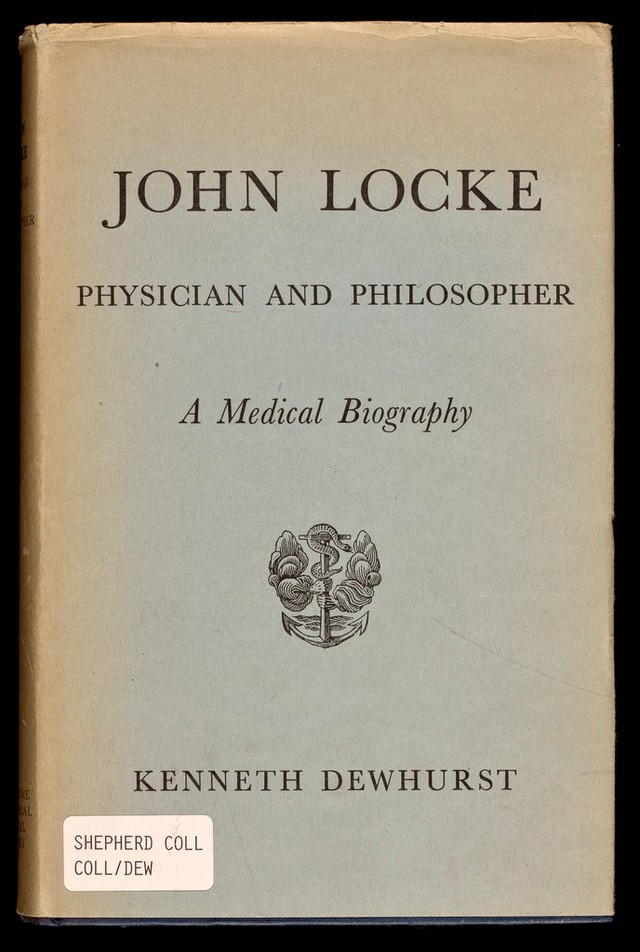
John Locke, 1632-1704, physician and philosopher : a medical biography / with an edition of the medical notes in his journals.
- Kenneth Dewhurst
- Date:
- 1963
Licence: Attribution-NonCommercial 4.0 International (CC BY-NC 4.0)
Credit: John Locke, 1632-1704, physician and philosopher : a medical biography / with an edition of the medical notes in his journals. Source: Wellcome Collection.
190/374 page 160
![of Sydenham's friends, whom he had known at school, and later at Oxford, where they attended Willis's lectures. In 1680 Needham re signed as physician to the Charterhouse in favour of Goodall, and was then practising in Great Queen Street, where Locke occasionally visited him. He also knew Sir John Micklewaite, President of the College of Physicians, and Edmund Dickinson, a Court physician and iatrochemist, described by Münk 1 as the highest authority on that subject in this country. Meanwhile, Shaftesbury had been acquitted of treason amidst scenes of public acclamation. Hitherto, he had persistently sought to secure a Protestant succession by constitutional means, but as all his designs had been crushed by the King's arbitrary acts, he now set out to achieve bis ends by revolution. But there was dissension amongst the Whigs: Shaftesbury favoured the Duke of Monmouth for the throne, whereas Halifax's candidate was William, Prince of Orange. Although he did not command the full support of the opposition, Shaftesbury went ahead with his plans; and Locke's frequent travels mystified the Tory spy, Prideaux, 2 who twice reported his suspicions of Whig intrigues. At the beginning of 1682, Locke made two new friends who were destined to play an important part in his life: Damaris Cudworth, daughter of Ralph Cudworth, the Cambridge Platonist, who came closer to Locke than any other human being, 3 and Edward Clarke, a wealthy landowner who had married Locke's cousin. He soon became the Clarkes' medical adviser; and many of his other friends chose to consult him in preference to their local practitioners. Shaftesbury's high regard for Locke's services is apparent in his secretary's letter. My Lord's Ague being returned [wrote Stringer], 4 and his taking of the Jesuits Powder not having its usuali effect to stopp it, he is reduced to an extream weaknes, and we all feare in exceeding danger. We have therefore sent this bearer on purpose to drive you to hasten to Toune, for we all hope better successe from you than he is like to have from the other doctors. ... When Shaftesbury recovered, Locke treated Stringer's pox with mecurial salivation, and the patient's wife 5 reported satisfactory progress, as he spitt three gallons since he entered into this course. Throughout 1682 Thomas repeatedly urged Locke to join him in 1 The Roll of the College of Physicians of London (1878), ed. William Münk, vol. I, p. 472. 2 B.M., Add. MS. 28,929,14 March, 1681/2; Ibid., f. 96, 19 March, 1681/2. a Maurice Cranston, op. cit., p. 215. 4 B.L., MS. Locke, c. 19, ff. 112-13 (undated). 6 Ibid., ff. 97-8, 8 April, 1682.](https://iiif.wellcomecollection.org/image/b20086283_0190.JP2/full/800%2C/0/default.jpg)
 No text description is available for this image
 No text description is available for this image
 No text description is available for this image