John Locke, 1632-1704, physician and philosopher : a medical biography / with an edition of the medical notes in his journals.
- Kenneth Dewhurst
- Date:
- 1963
Licence: Attribution-NonCommercial 4.0 International (CC BY-NC 4.0)
Credit: John Locke, 1632-1704, physician and philosopher : a medical biography / with an edition of the medical notes in his journals. Source: Wellcome Collection.
32/374 page 12
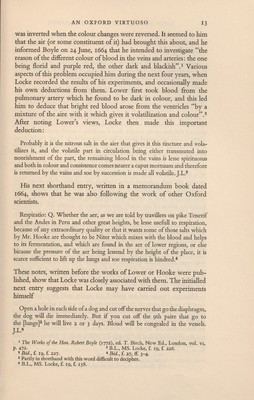
![Amongst the topics he discussed were pain, sleep, nutrition, epilepsy, hysteria, arthritis, purging, narcotics, and the medicinal use of sulphur which was one of his favourite remedies for chest complaints. Dr. Willis imparts his receipts chiefly to 2 Apothecaries in Oxford [writes Ward], 1 so farre as I can perceive, Mr. Hazelwood and Mr. Crosse. Hee hath a syrup of sulphur which hee makes much use of. Itt is Iiis ownc composition and no Apothecarie hath itt or knowes itt but the two forementioned. It may be taken and is so usually with a Liquorish stick. It is a compound not above 4d an ounce, but it is most used in Colds and distempers of the lungs. In 1658 Richard Lower began to investigate the problem of the physiology of respiration. Dr. Willis and Dick Lower opened a Dogg [wrote Ward], 2 and they first let him blood in the jugulars to discover whether arterial and venal blood did differ in colour and constitution. This was the first of a series of experiments and observations made by Lower, Hooke, and Boyle during the next decade, which greatly extended the knowledge of pulmonary physiology. Locke was also interested in their work. The prevailing theory of respiration was still that of the Galenists. They believed that breathing served to cool the innate heat of the heart, whose pumping action removed foul vapours, and allowed air to mix with the blood, so that the vital spirits could be generated in the left ventricle. Both foul vapours and pure air were thought to flow through two separate channels in the pulmonary vein in spite of the fact that Harvey's discovery of the circulation had demonstrated the absurdity of this notion. His work had shown that venous blood was changed to arterial during its passage from the right to the left side of the heart. How had this colour change been brought about? What was the role of the air in respiration? What was the function of the diaphragm, and what physiological purpose did respiration serve? These were some of the questions the Oxford scientists were trying to answer when Locke began to follow their experiments in 1664. Boyle's investigations four years previously had given a great impetus to their research, although one of his conclusions was misleading. He failed to realize that this essential element or quintessence was actually part of the air; and his notions of the heart's role in respiration were archaic. Lower, with a better knowledge of anatomy and physiology, was particularly in terested in the part played by the air in altering the colour of the cir culating blood. He noticed that the upper surface of a blood clot was florid, whereas the under surface remained dark until the blood clot 1 John Ward and his Diary, Sir D'Arcy Power, op. cil., p. 191. 3 Ibid., p. 186.](https://iiif.wellcomecollection.org/image/b20086283_0032.JP2/full/800%2C/0/default.jpg)



 No text description is available for this image
 No text description is available for this image
 No text description is available for this image