John Locke, 1632-1704, physician and philosopher : a medical biography / with an edition of the medical notes in his journals.
- Kenneth Dewhurst
- Date:
- 1963
Licence: Attribution-NonCommercial 4.0 International (CC BY-NC 4.0)
Credit: John Locke, 1632-1704, physician and philosopher : a medical biography / with an edition of the medical notes in his journals. Source: Wellcome Collection.
36/374 page 14
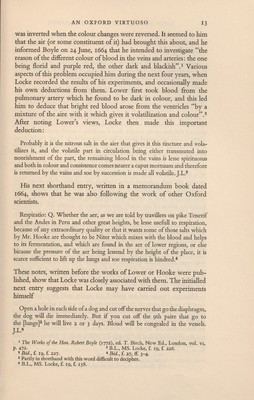
![This experiment gave him an understanding of the diaphragm's role in respiration, and his next entry implies a grasp of the mechanics of artificial respiration. If upon cutting off the nerves of the diaphragm the cause of sudden death be want of respiration, why cannot the motion of the thorax supply that at least for a little time unlesse the looseness of the diaphragm hinder it. J.L. 1 The problems of the Oxford physiologists could only be solved by animal experiments which Locke occasionally planned, and probably also helped to carry out. Query: Does the air enter the cavity of the thorax through the lungs? Try this experiment. Make a wound in the thorax so that air enters. When the thorax is full shut up the wound, then if anything is breathed out through the mouth it must have passed through the membrane of the lungs. To this it can be objected that the pores of the lungs are more constricted when the lungs are collapsed than when they are expanded. J.L. 2 Robert Hooke's work led to the next advance. He opened the thorax of a dog, and then blew air from a bellows into the trachea : the air escaped through puncture holes made in the outside of the lungs. This experiment, incorporating some of Locke's and Lower's suggestions, demonstrated that a continuous supply of fresh air (as well as the pumping action of the heart) was necessary to sustain life. Hooke in formed Boyle of his work which he felt squeamish about repeating. The other Experiment (which I shall hardly, I confess, make again, because it was cruel) [wrote Hooke], 3 was with a dog, which, by means of a pair of bellows, wherewith I filled his lungs and suffered them to empty again, I was able to preserve alive as long as I could desire, after I had wholly opened the thorax, and cut off all the ribs, and opened the belly. . . . My design was to make some enquiries into the nature of respiration. But I shall hardly be induced to make any further trials of this kind, because of the torture of the creature; but certainly the enquiry would be very noble if you could any way find a way to stupify the creature, as that it might not be sensible. Although Hooke did not publish his results until three years later, Lower's modification of this experiment led to a great advance. Earlier he had believed that the difference in colour between venous and arterial blood was due to fermentation taking place in the heart, until he found that this theory was not borne out by experiment. He first cut the larynx of a dog and plugged it with a cork, so that air could not get into the lungs. Then he examined blood in the cervical artery of 1 B.L., MS. Locke, f. 19, f. 158. 2 Ibid., f. 19, f. 338. 3 T. Birch, op. cil., vol. VI, p. 498, 10 Nov., 1664.](https://iiif.wellcomecollection.org/image/b20086283_0036.JP2/full/800%2C/0/default.jpg)



 No text description is available for this image
 No text description is available for this image
 No text description is available for this image