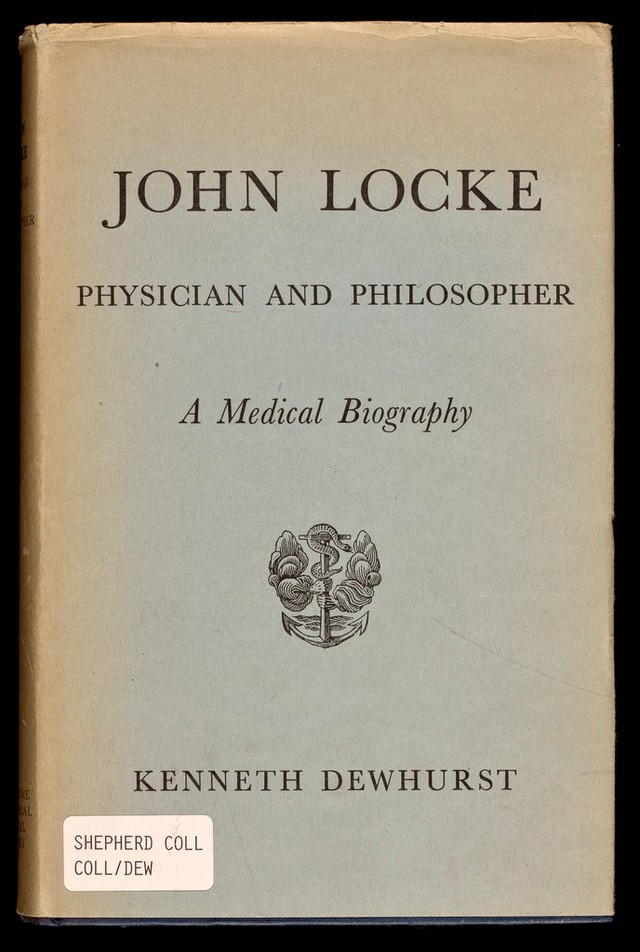
John Locke, 1632-1704, physician and philosopher : a medical biography / with an edition of the medical notes in his journals.
- Kenneth Dewhurst
- Date:
- 1963
Licence: Attribution-NonCommercial 4.0 International (CC BY-NC 4.0)
Credit: John Locke, 1632-1704, physician and philosopher : a medical biography / with an edition of the medical notes in his journals. Source: Wellcome Collection.
57/374 page 35
![right, manly, and simple : it was more characteristic of a cavalry officer than of the polished courtly physicians who were his main critics. They were mostly bookish men, these orthodox doctors, whereas Sydenham was essentially a man of action, basing his treatment not so much on the authority of ancient writers as upon his own carefully observed natural history of a patient's illness. He set aside all vain philosophical hypotheses in studying the manifest phenomena of disease and, like Hippocrates, realized that nature often works her own cure with a few simple remedies, and frequently without any medicine at all. Sydenham believed that the remote causes of disease were not only outside the scope of the physician's art, but beyond the range of human under standing, and he resisted the temptation to speculate upon their true nature, confining himself instead to healing in harmony with nature. The treatment of infectious fevers was his main concern. The Great Plague which two years earlier had ravaged the metropolis leaving over 100,000 dead, had now spent itself; but bad drainage, poor ventilation, overcrowding, and a general lack of cleanliness provided a steady focus for the rapid spread of epidemic diseases, which still caused such a heavy mortality that the population of London could only be kept at a constant level by a regular supply of fresh blood from the country. Epidemics of smallpox were then causing most havoc. Out of a metro politan population of about 500,000, there were 16,000 deaths in 1667 and 17,000 in the following year, of which smallpox accounted for 1,196 and 1,468 respectively. 1 Sydenham believed that many of these deaths were due to the hidebound incompetence of physicians who still treated their patients with heating medicines in the vain hope of forcing out the seeds of the disease, instead of adopting the more natural cooling regimen which he was then advocating. Locke was interested in this cooling treatment, and began to accompany Syden ham on visits to patients, where he saw its efficacy. When sending Boyle a copy of the second edition of his book on fevers, to which Locke had prefixed a Latin poem, Sydenham mentioned their visits. I perceive my friend Mr. Locke hath troubled you with an account of my practise [wrote Sydenham], 2 as he hath done himself in visiting with me very many of my varioulous patients especially. It is a disease, wherein as I have been more exercised this year than ever I thought I could have been, so I have dis covered more of its ways than ever I thought I should have done. Here we have clear evidence of Locke's clinical work with Sydenham, particularly his interest in the cooling treatment of smallpox, which he 1 Charles Creighton, op. cit., vol. n, p. 10. 2 T. Birch, op. cit., vol. vi, pp. 648-9, 2 April, 1668.](https://iiif.wellcomecollection.org/image/b20086283_0057.JP2/full/800%2C/0/default.jpg)


 No text description is available for this image
 No text description is available for this image
 No text description is available for this image