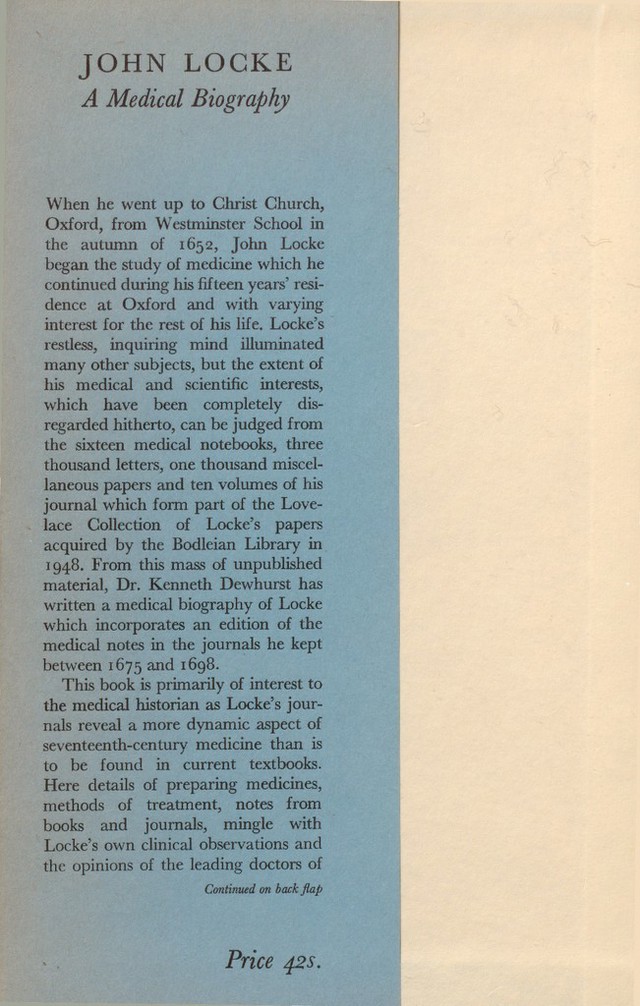
John Locke, 1632-1704, physician and philosopher : a medical biography / with an edition of the medical notes in his journals.
- Kenneth Dewhurst
- Date:
- 1963
Licence: Attribution-NonCommercial 4.0 International (CC BY-NC 4.0)
Credit: John Locke, 1632-1704, physician and philosopher : a medical biography / with an edition of the medical notes in his journals. Source: Wellcome Collection.
79/374 page 53
![or discussed the preparation of medicines with the apothecaries, and frequently wandered round the excellent botanical gardens, 1 making notes on the plants, and getting practical tips from the head gardener. Unfortunately, Locke did not visit St. Eloy Hospital where Raymond Vieussens (1641-1713) was performing post-mortems, which provided facts for his Neurologia Universalis, etc. (1683) with its description of the inferior medullary velum which is still known as the valve of Vieussens. 2 He is said to have conducted over five hundred post-mortem examina tions, upon which he based his pioneer work on the pathology of the heart. 3 Locke stayed in Montpellier (apart from brief excursions to Provence and along the Mediterranean coast) for the next fifteen months. With Charleton he visited Balaruc and made notes on the medicinal properties of the waters, and in the spring of 1676, journeyed into Provence, staying at Aix, Avignon, Hyères, and Toulon. At Aix, Locke was warmly received by Dr. Claude Brouchier, physician to Archbishop Grimaldi, and Professor of Chemistry, who gave him much information. Locke's own health was not improving as quickly as he had hoped, and through Mapletoft he got Sydenham's opinion. I acquainted Dr. Sydenham with all that relates to your health [replied Mapletoft], 4 of which I found you had given him a later account than mine was. He threatens to write to you himself but in the mean time desires me to tell you that he lays the main stresse of your Cure upon Alteresty as he calls it, and would therefore advise you to give yourselfe up to the Dyet of the Country you are in, eating and drinking as they doe, without which he doth not expect much from the aire. He thinks you should drink wine and water together, as they doc rather than the pure Element, and that you should forbeare Milke then make so constant use of it. He mislikes not your being bled once, but doth not advise to repeate it, nor take any kind of Physick. I hope you will find all the advantages you could propose to yourselfe in your journy and that you will shortly return to us in perfect good health. I am glad you found Dr. Brouchier so much the Man I promised you, he expresses great satisfaction in you likewise so that I pretend to have served you both. Dr. Coxe 5 laments your not coming with his Son, but ows his obligations to you for the kindness you did him whilst you were together. My Lady Northumberland hath been at Bristoll and Bathe and dranke of both those Minerali Waters, but without any great effect. 1 Reviewed by Hervé Harant, Le Jardin des Plantes de Montpellier, Endeavour (1959), 13. 97 -IOO. ' C. G. Cumston, The Portrait of Vieussens, Ann. Med. Hist. (1921), 3, 86. 3 Sir D'Arcy Power and C.J. S. Thompson, op. cit., London, p. 121. 4 B.L., MS. Locke, c. 15, ff. 205-6, 28 June, 1676. 5 Dr. Thomas Coxe came from Somerset. He studied medicine at Padua, and was incorporated M.D. at Oxford in 1646. Coxe was one of the original Fellows of the Royal Society, and became President of the College of Physicians in 1682. According to Payne he persuaded Sydenham to devote himself to medicine on his return from the Civil War.](https://iiif.wellcomecollection.org/image/b20086283_0079.JP2/full/800%2C/0/default.jpg)


 No text description is available for this image
 No text description is available for this image
 No text description is available for this image