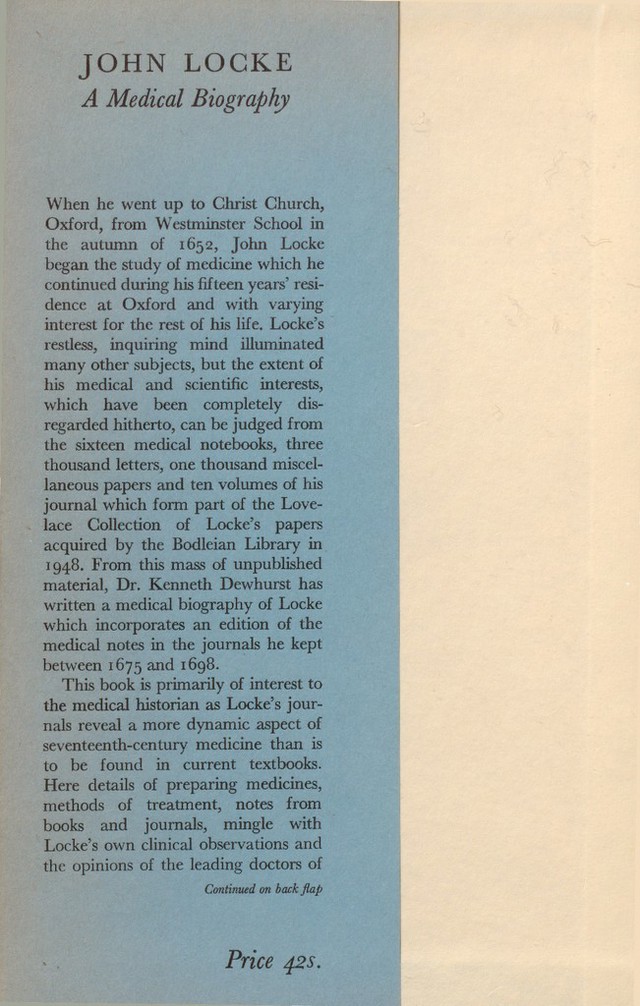
John Locke, 1632-1704, physician and philosopher : a medical biography / with an edition of the medical notes in his journals.
- Kenneth Dewhurst
- Date:
- 1963
Licence: Attribution-NonCommercial 4.0 International (CC BY-NC 4.0)
Credit: John Locke, 1632-1704, physician and philosopher : a medical biography / with an edition of the medical notes in his journals. Source: Wellcome Collection.
81/374 page 55
![Locke and his pupil stayed over a year in Paris, where they moved in the intellectual milieu. Locke met François Bernier (1620-88), physician and Orientalist, who abridged and popularized Gassendi's philosophy; Adrien Auzout (1622-91), a leading mathematician and astronomer who improved Huygen's astronomical micrometer; Hubin and Hautefueille, well-known inventors, and Samuel DuClos (d. 1715), physician to Louis XIV, and founder-member of the Académie des Sciences whose meetings Locke attended at King's Library, Versailles. He met more friends through Henri Justel, Secrétaire du Roi, who held a weekly salon, where Locke was introduced to Nicolas Thoynard (1629-1700) with whom he corresponded on scientific subjects long after his return to England. Thoynard, born at Orleans, had travelled widely before settling in Paris, where his interests ranged from Biblical studies to science and technology : at his home Locke witnessed experi ments on fermentation, and collected information on the technicalities of artillery. Locke lodged with Moïse Charas (1618-98) in the Rue de la Bou cherie off the Faubourg St. Germain, near the Faculty of Medicine. Charas, then demonstrator in chemistry at the Jardin des Plantes, was particularly interested in the medicinal properties of viper's flesh, and the effects of the venom. 1 Locke witnessed some of his experiments. They were designed to test van Helmont's theory that a reptile's saliva was normally free from venom, which accumulated only when the animal was enraged or terrified. The unorthodox nature of these experiments, and the fact that Charas was a Protestant, brought about his prosecution a few years later on a charge of attempting to over throw an established belief. He sought asylum in England where he became apothecary to Charles II. In the summer of 1677 Locke had hopes of a medical appointment on his return to England, as Mapletoft had long promised him the Chair of Physic at Gresham College, but rumours of his impending resignation brought forth one eager applicant ready to purchase his appointment. I shall acquaint you with an overture lately made to me [wrote Mapletoft], 2 by a good Friend of mine who suspecting I might be more inclinable to Matrimony then formerly came on purpose to tell me, that when I designed to leave, he will take it as a favour if I would accept £200 from him, and assist him in being my Successor, which he doubts not of Compassing almost by his 'Locke's notebook (1660-93) (MS. Locke, d. 9, f. 31) contains the following entry: We have experimented that vipers skins doe perfectly heale the inveterate mange in dogs making them eat it boiled or raw. Charas of Vipers, p. 157, 70. Q. Whether it may not be as effectuall for scab or leprosie in men? J L. S B.L., MS. Locke, c. 15, if. 209-10, 11 Oct., 1677.](https://iiif.wellcomecollection.org/image/b20086283_0081.JP2/full/800%2C/0/default.jpg)


 No text description is available for this image
 No text description is available for this image
 No text description is available for this image