Insects of Samoa and other Samaon terrestrial arthropoda. Pt. 6, Fasc. 2, Nematocera / by F.W. Edwards.
- Edwards, F. W. (Frederick Wallace), 1888-1940.
- Date:
- [1928?]
Licence: In copyright
Credit: Insects of Samoa and other Samaon terrestrial arthropoda. Pt. 6, Fasc. 2, Nematocera / by F.W. Edwards. Source: Wellcome Collection.
18/84 page 38
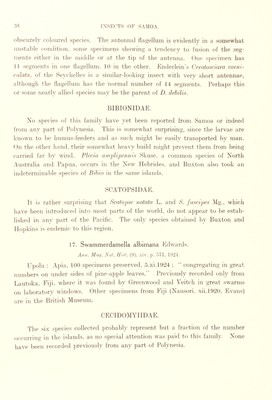
![obscurely coloured species. The luitennal Hagellum is evidently in a somewhat unstable condition, some specimens showing a. tendencv to Fusion of the seg¬ ments either in the middle or at the tip of the antenna. One specimen has 11 segments in one flagellum. 10 in the other. Enderlein's (Jmilosdum cornl- cnlata. of the Seychelles is a similar-looking insect with very short antennae, although the flagellum has the normal number of 14 segments. Perhaps this or some nearly allied species may be the parent of D. debilis. BIBIONIDAE. No species of this family have yet been reported from Samoa or indeed from any {)art of Polynesia. This is somewhat surprising, since the larvae are k'uown to be humus-feeders and as such might be easily transported by man. ()n the other hand, their somewhat heavy build might ])revent them from being carried far by wind. Plecia amplipennis Skuse. a common species of North Australia and Papua, occurs in the New Hebrides, and Buxton also took an indeterminable .species of Bibio in the same i.slands. SCATOPSIDAE. ft is rather sur])rising that Scatopse notata L. utkI N. fuscipe.'^ Mg., which have been introduced into most parts of the world, do not appear t(j be estab¬ lished in anv part of the Pacific. The only species obtained by Buxton and llojjkins is endemic to this region. 17. Swammerdamella albimana Edwards. Xat. IIisl. (9). xiv. ]). 1921. l.fpolu : Apia. 100 .specimens preserved, 5.xi.l924 ; “ congregating in great numbers on under sides of pine-apple leaves.” Previously recorded only from Lautoka, Fiji, where it was found by (Greenwood and Veitch in gTeat swarms on laboratory windows. Other specimens from Fiji (Nau.sori. xii.1920. Evans) are in the British Museum. CECIDOMYIIDAE. 'riie six s])ecies collected ])robably represent but a fraction of the number occurring in the islands, as no .special attention was paid to this family. None have been recorded previously from any part of Polynesia.](https://iiif.wellcomecollection.org/image/b29809071_0018.jp2/full/800%2C/0/default.jpg)