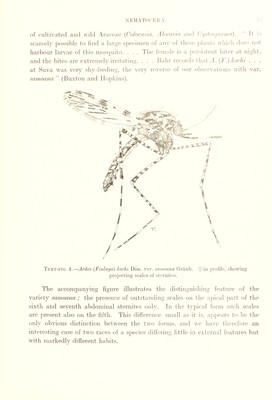
Insects of Samoa and other Samaon terrestrial arthropoda. Pt. 6, Fasc. 2, Nematocera / by F.W. Edwards.
- Edwards, F. W. (Frederick Wallace), 1888-1940.
- Date:
- [1928?]
Licence: In copyright
Credit: Insects of Samoa and other Samaon terrestrial arthropoda. Pt. 6, Fasc. 2, Nematocera / by F.W. Edwards. Source: Wellcome Collection.
26/84 page 46
![K) 28. Aedes (Aedimorphus) vexans (Mg.). ( i(li‘x V(X(nis Mciifcn, SifsI. Jicscliy., vi, ]). 211, 1830. OclihxolKtiis rcxniif! J^dvvurds, Bull. Et)!. lies, vii, |). 218, 1017. Aihlrs {Aedimorpints) vexans Fdwards, Ball. Eiil. Res., xvi, p. 372, 1021 ; Huxtoii and ll()|ikin.s, Researches in Rohjnesia atid Melanesia, p. 01, 1927. V(’xa)is has been recorded from several localities on or near the coast: Lanlii, Alulifaima, and Alei])ata, in Upohi, and Tiiasivi, in Savaii. Apart from being widely sjrread in the Palaearctic*, Nearctic and Oriental regions, it occurs on many other Pacilic Islands, including the New Hebrides, New Caledonia, Fiji and Tonga, but there are no certain records from farther east than Samoa. The larvae occur always in shallow temporary pools and marshes. 29. Culex samoaensis (Theobald). Pseadotaeniorrhtptchas satnoanisis Theobald, Entom. xlvii, p. 36, 1014. Ctdcx samoaensis Edwards, Bull. Ent. Res., xiv, ji. 394, 1924 ; Buxton and Hopkins, Researches in Pohjnesia and Melanesia, p. 78, 1927. This species was described from two females collected in a privy at x4pia by Friederichs ; a third female specimen taken in Samoa (no exact data) by O’Connor is in the British Museum. Buxton and Hopkins were unable to find the species. So far as can be judged from the known examples it is to be regarded as a distinct local development from C. hitaeniorhynchus or some related species. 30. Culex annuhrostris Skuse. Proc. Linn. Soc. AkS.lT. (2), iii, p. 1737, 1889 ; Edwards, Bull. Ent. Res., xiv, p. 394, 1924 ; Buxton and Hopkins, Researches in Puh/nesia and Melanesia, p. 79, 1927. Culex jejjsoni O'Connor {nec Theobald), Research Mem. 4, London Sch. Trop. Med., 1923. “ In Samoa, larvae were found in every month of the year, in a consider¬ able variety of breeding places, but generally in clean water which contained filamentous gi'een algae. We have several records from water in hoof marks, with or without algae ; we also found this species in stagnant pools, and in slowly running ditches among taro ; it occurred also in an open concrete drain in the Apia hospital. . . . We obtained larvae on Upolu and Tutuila, but not on Savaii, where the species doubtless occurs. . . . Though the larvae were common in Samoa, we never found the adults wild. In the New Hebrides they bit savagely at night on the island of Mai ; in Funafuti, in the Ellice gi’oup, they made life a biuxlen by day and by night ...” (Buxton and Hopkins).](https://iiif.wellcomecollection.org/image/b29809071_0026.jp2/full/800%2C/0/default.jpg)