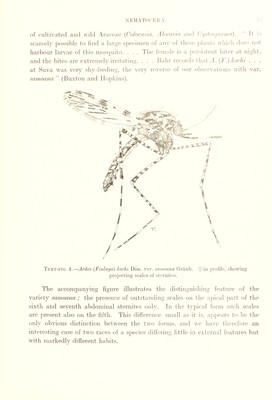
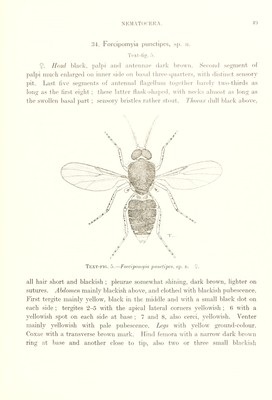
Insects of Samoa and other Samaon terrestrial arthropoda. Pt. 6, Fasc. 2, Nematocera / by F.W. Edwards.
- Edwards, F. W. (Frederick Wallace), 1888-1940.
- Date:
- [1928?]
Licence: In copyright
Credit: Insects of Samoa and other Samaon terrestrial arthropoda. Pt. 6, Fasc. 2, Nematocera / by F.W. Edwards. Source: Wellcome Collection.
30/84 page 50
![dots bciieiitli. Each til)ia on the outer side witli foiu- to six black dots, larger ones alternating with small ones. h]ach tarsal segment cxce2)t the last narrowly black at the tip. No scales on legs ; bristles and shorter hairs yellowish. First segment of hind tarsi about half as long as second. Witujs without markings ; hair dense and very dark ; base }’ellowish ; costa not quite reaching the middle. Haltercs yellow, with a small black dot on iq)per surface of knob. Wing- length 1-7 mm. Upolu : Malololelei, 2,000 ft., 1 $, 25.xi.1924. I have neither seen nor read of any other species which at all resembles this in leg-markings. 35. Forcipomyia swezeyl, sp. n. (J. Head dark, including antennae and palpi; tip of antennal plume creamy (terminal segments of flagellum missing in case of type). Thorax dark brown, mesonotum with a mixture of yellowish and black scaly hairs. Abdomen blackish, unmarked, with dark bristles and narrow scales. Legs covered with small close-hung scales. Ground coloiu' yellow ; front and middle femora more or less darkened towards base ; hind femora blackish on the basal two-thirds ; front and middle tibiae with a dark brown ring near base and a much broader one beyond middle, space between the rings lighter brown ; hind tibiae black on about basal tliree-quarters, tip yellow ; front tarsi yellow, with third seg¬ ment dark ; middle and hind tarsi with blackish rings at bases of first three segments, fourth segment entirely dark. First hind tarsal segment about 1-4 times as long as second. Wings rather rubbed in case of type ; the hair apparently mostly pale, exce2)t for a black patch over the radial cells, and traces of a second on the front margin before the tijD ; no indication of other markings. Costa reaching just beyond middle. Venation normal. Halteres with yellowish stem and black knob. Wing-length 1-5 mm. Tutuila : Pago Pago, 1 10.ix.l923 (Swezey). According to Kieft’er's key to the group Lepidohelea (scaly-legged Forci¬ pomyia), this species would appear to be L. lepidopus Kieff. (New Guinea), the description of which is inadequate for comparison ; Kiefier does not mention a dark spot over the radial cells nor a liglit area in the middle of the anterior tibiae, nor does he indicate the hind tarsal proportions in his type.](https://iiif.wellcomecollection.org/image/b29809071_0030.jp2/full/800%2C/0/default.jpg)